When a lead opens with “how much does it cost,” answer the price first. I learned this across years of running sales teams, and the rule holds everywhere. Give a clear starting figure or a realistic range, add one line on what moves the final number, then ask a single easy question. Dodging with “it depends, book a call” ends most chats before they begin.
I have spent most of my career inside sales teams. Clinics, coaching institutes, home services, different products with very different price tags. One pattern never changed. The first message a lead sends is almost always about money. “How much for a hair transplant.” “What does the course cost.” “Price please.” For a long time I watched good reps fumble that exact moment, and the fix was never a better pitch. It was a faster, cleaner follow-up, the kind a lead follow up CRM for small business is built to enforce.
Why the first message is almost always about price
A buyer who leads with price has usually done some homework already. They know they want the thing. What they do not know is whether they can afford it, and whether you are worth more of their time than the three other businesses they messaged this morning.
That last part matters. A price-first lead is rarely talking to you alone. They are comparing, and they are deciding fast. So the question is not really “how much.” The real question underneath is “can I trust you, and are you going to waste my time.”
The two replies that kill the deal
Most reps fail a price-first message in one of two ways.
The first is quoting blind. They fire off a number before they know anything about the buyer. If that number lands high with no context, the lead goes quiet. If it lands low, they just capped a deal that was worth more.
The second is dodging. “It depends on your requirement, please book a consultation.” To the rep this feels careful. To the buyer it reads as hiding something, or worse, as “this must be expensive.” On WhatsApp especially, where people expect a straight reply, the dodge gets you left on read.
Both reactions come from the same mistake. The rep treats the price question as something to get around instead of something to answer.
The rule I gave every team: answer first, qualify second
The rule is simple. Answer the price question, then ask one question. Not a questionnaire. One.
You give the buyer what they asked for, which earns the trust to keep talking. Then the single follow-up question moves the chat toward the next step without feeling like an interrogation. That is the whole move. It sounds obvious written down, yet almost nobody does it under live pressure.
What happened at the clinic
The clearest example came from a team selling hair transplants. The first message was nearly always “how much does a hair transplant cost.” Some reps quoted a flat price without knowing the patient’s case. Others replied “it depends on your condition, please book a consultation.” Both lines ended the conversation before it started.
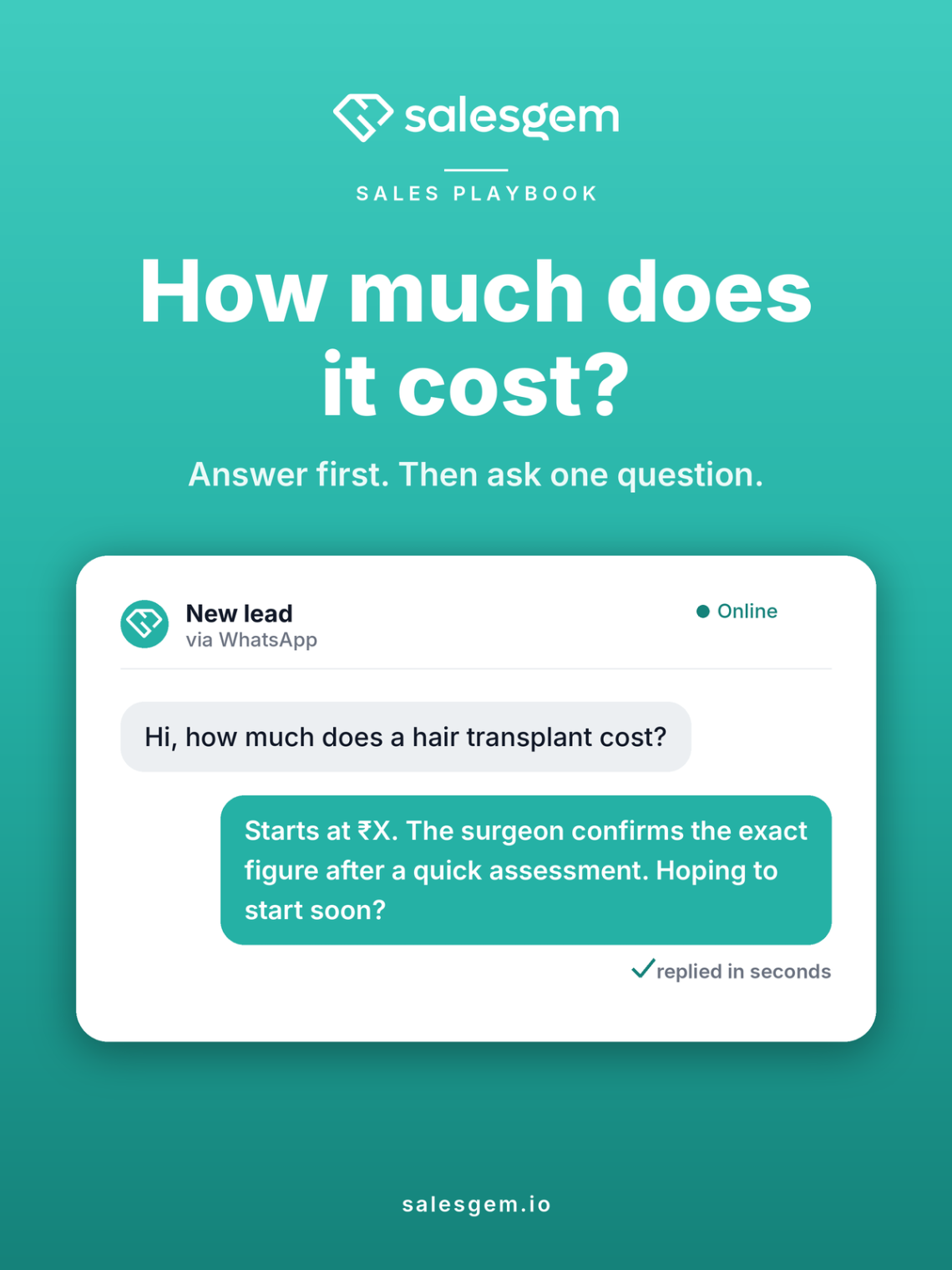
So I changed the script. Reps were trained to answer the price first, explain in one line what changes it, then ask one easy question. It sounded like this:
Hair transplants are priced by the number of grafts your case needs. Ours start at [Starting price], and the surgeon confirms the exact figure after a quick assessment. Are you hoping to start treatment soon?
The patient gets a real anchor. They learn why the final number varies, which makes the eventual estimate feel honest rather than inflated. And the closing question points at the only thing that actually closes a clinic sale, which is booking the consult. We stopped trying to win the sale inside the chat and started trying to win the appointment.
What happened with the education team
The same problem showed up selling education programs, just with a different trigger. Messages like “how much is your course” arrived through Facebook and WhatsApp all day. Some reps waited until they had time for a full sales conversation before replying. By then the prospect had already enrolled somewhere else. Others sent only the fee, with nothing about payment plans or what was included, and watched the lead vanish over sticker shock.
We put in one standard first reply. Acknowledge the question, give the fee or range, mention installments where they apply, ask one question.
The program fee starts at [Starting fee], and we offer monthly installments for eligible students. Are you looking at the full program or a shorter track?
That one change taught me something I now repeat constantly. A price-first message is not automatically a low-quality lead. Some buyers are ready to enrol and just need a transparent number to move. Others need a little more before they decide. A helpful first reply gives both groups a reason to keep going. Label every price-asker a tyre-kicker and you throw away your hottest buyers along with the cold ones.
Three scripts for the three situations you will face
Give your reps approved lines so they are not improvising on a hot lead. Nearly every price-first message falls into one of three buckets.
When you have a fixed price
Say the number, attach the main inclusion, offer the next step.
The plan is [price] a month, and that covers [key inclusion]. Want me to get you set up, or is there something you want to check first?
When you can only give a range
Give the range, name the one variable that moves it, then ask what they need.
Most clients in your situation land between [low] and [high], depending on [the main factor]. Can I ask what you are trying to solve first, so I point you to the right option?
When the price truly needs an assessment
This is where reps are tempted to dodge. Do not. Explain why a flat number would be guessing, then make the next step feel like a favour, not a hurdle.
Solar pricing depends on your roof and your monthly bill, so a flat figure would just be a guess. Send me a recent electricity bill and I will have a real estimate back to you today. Sound good?
Notice that even the assessment script answers the question. It tells the buyer honestly why there is no single number, which is a far cry from “it depends, book a call.”
Stop scoring yourself on leads received
Here is the metric change that moved the needle most. Teams love to count leads received. It feels like progress and it tells you almost nothing.
For price-first inquiries, track three things instead. How fast the first reply went out. Whether the lead replied. And how many consultations or appointments got booked from those chats. Once a manager can see those numbers per rep, the coaching writes itself. You can finally tell the difference between a rep who answers in two minutes and books half their chats, and one who answers in two hours and books none.
Why speed decides who gets the booking
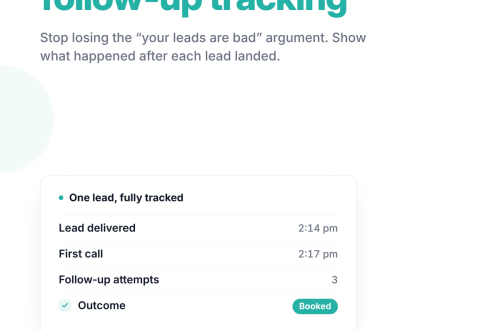
Everything above assumes the rep actually sees the message in time. On Facebook, Instagram, and WhatsApp, that assumption breaks all the time. A “how much” message sits in a shared inbox, nobody owns it, and the fast business down the road books that customer while your rep is still at lunch.
This is where the tooling earns its keep. Salesgem captures your Facebook, Instagram, and WhatsApp leads the instant they arrive and routes each one to the right rep’s phone, so the price question gets a human answer while the buyer still cares. The goal is plain. Reply before your competitor does.
If slow follow-up is quietly costing you booked appointments, you can try it free. No credit card needed, 14 day free trial, free support and migration. Sign Up and route your next batch of price first leads properly.
What I tell sales managers now
After all of it, my advice comes down to four lines.
Answer the price. Hiding it never builds trust, it kills it. Ask one question, not ten, and make the next step a small yes. Treat the price-asker as a likely buyer until they prove otherwise. And get the first reply out fast, because on social and WhatsApp, speed is most of the sale.
The question was never the problem. How long you take to answer it, and what you say in that first reply, is the whole game.
FAQ
Give it in the first message. A buyer who asks “how much does it cost” wants a number, and withholding it reads as evasive. Share a starting figure or a realistic range, add one line on what changes the final cost, then ask a single question. You can qualify fully once the conversation is actually moving.
Say so plainly, and still give the buyer something. Explain in one sentence why a flat number would be a guess, such as pricing depending on their roof size or case complexity. Then make the next step easy, like sharing a bill or a photo, and promise a real estimate quickly. That is honest, not a dodge.
No. It changes the order. You answer the question the buyer actually asked, which earns the right to keep talking, then qualify with one easy follow-up instead of a long form. Front-loading questions before the buyer gets their answer is what drives price-first leads away, so answer first and qualify as the chat continues.
Not usually. Many price-first buyers have already decided they want the product and only need a clear number to move forward. Others are early and comparing options. Both are worth a helpful reply. Treating every price question as a tyre-kicker means ignoring some of your most ready buyers, so respond well and let their replies tell you who is serious.
As close to instant as you can manage. Price-first buyers on Facebook, Instagram, and WhatsApp are almost always messaging several businesses at once, and the first helpful reply tends to win the booking. A message that sits for an hour is usually a lead a faster competitor already closed. Routing leads straight to a rep’s phone keeps that window from closing on you.