“Client says the leads didn’t convert” is a sentence every agency running Facebook and Instagram lead campaigns eventually hears, and after a decade managing sales teams across clinics, training institutes, and home-service companies, I have learned the explanation is rarely about the leads themselves. It is almost always about what happened, or did not happen, in the hours after a lead arrived.
The conversation every agency dreads
I have sat in this meeting more times than I can count. A client pulls up a spreadsheet of names from last month’s campaign, points at the bottom line, and says some version of the same sentence. The leads didn’t convert. The campaign isn’t working. Maybe we should pause spend.
Nobody in that room, on either side of the table, actually knows what happened to those leads after they landed. That gap is where most agency relationships, including the lead delivery and accountability problem agencies deal with every month, start to break down.
What the call logs actually showed
When I was managing sales teams working Facebook lead campaigns for a paid media agency, the same complaint came up every few months. A client would flag that the leads were weak, that nobody was booking, that the agency needed to fix its targeting. I asked for something simple before changing anything: the call logs.
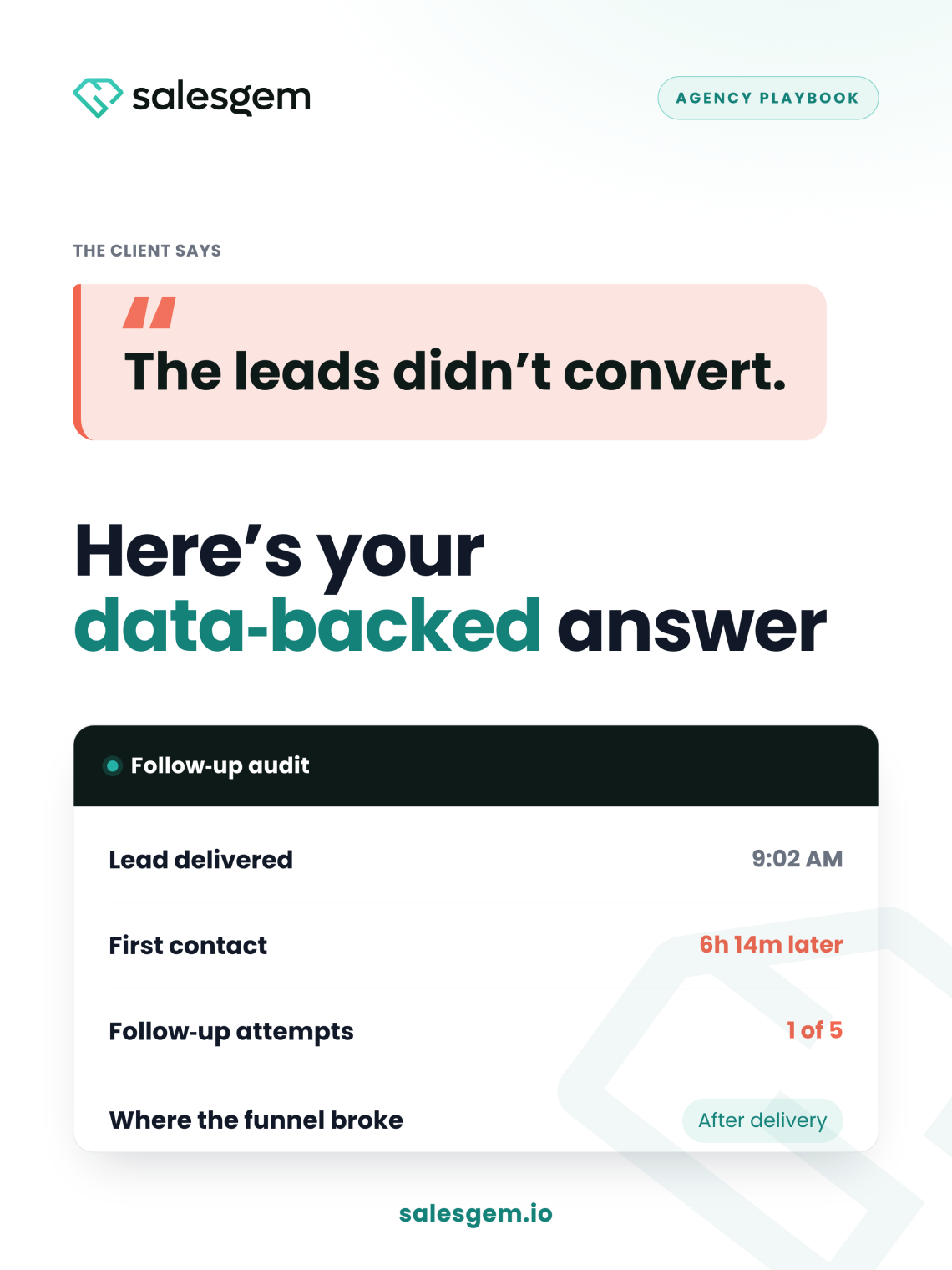
What I found was not a targeting problem. Leads had arrived in the client’s inbox hours before the first call went out, and in several cases nobody had called at all. The names were there, the phone numbers were valid, the agency had done its job. The breakdown sat entirely on the other side of the handoff, in the window between delivery and contact that nobody was tracking.
The pattern underneath the complaint
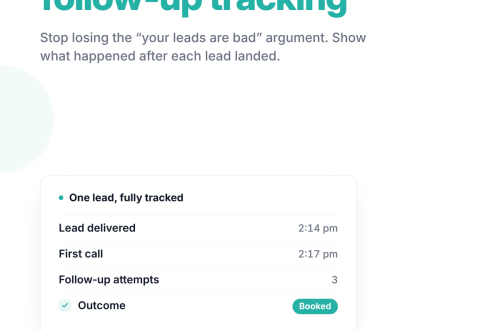
Lead volume alone cannot prove whether a campaign worked or failed. It only tells you how many names arrived, not what happened to them. Once I started tracking lead delivery time, first contact time, follow-up attempt count, and final outcome as four separate numbers instead of one blended verdict, the real story showed up immediately. Leads contacted within the first hour booked at a meaningfully higher rate than leads that sat for half a day or longer.
What I tell sales managers and agencies now
- Record the timestamp a lead arrives and the timestamp of the first outbound contact, for every lead, not a sample.
- Compare contact rates and booking rates for quickly contacted leads against delayed ones, so the gap is visible in numbers rather than anecdotes.
- Share a timestamped lead report with the client before the lead quality conversation even starts.
That shifts the meeting from an argument about whether the leads were good to a shared look at exactly where the funnel broke.
Why “low cost per lead” and “poor sales” can both be true
Years into managing lead-driven sales processes, I kept running into a second pattern. The agency’s report said cost per lead was strong. The client’s report said sales were weak. Both were telling the truth, because neither report showed the full path from first inquiry to closed deal.
At one aesthetic clinic I worked with, the front desk handled inbound leads alongside checking in patients, so a WhatsApp message or a form submission could sit untouched for an hour between appointments. At other businesses, the same lead would land in a shared inbox or a WhatsApp group with three people in it, and all three assumed someone else had already replied.
What changed once we measured every stage
Instead of judging the campaign on lead volume or the sales team on final conversions, I started asking both sides to look at every stage of the same funnel: leads received, leads contacted, leads qualified, appointments booked, deals closed. Most CRMs built for this kind of pipeline label those stages lead, marketing qualified lead, sales qualified lead, opportunity, and converted, with a timestamp recorded at each step. We also assigned one clear owner per lead and scheduled a follow-up reminder for anything that went untouched past a set window.
Advice I give on this one
- Review the conversion rate at every stage of the funnel, not just the final sale, so you can see exactly where leads drop out.
- Agree with the client on a reporting window that matches their actual sales cycle. A clinic booking consultations moves differently than a solar installer closing a financed deal.
- Where the tooling allows it, send qualified and converted outcomes back to the ad platform through a CRM integration and the Meta Conversions API, so ad delivery has something real to optimize against instead of raw form fills.
The lesson underneath both of these experiences is the same. Data has to separate campaign performance from sales execution. When both sides of the table are looking at the same funnel, the conversation stops being about blame and starts being about which specific stage, lead quality, response time, qualification, or follow-up, actually broke.
Industry patterns I keep running into
This complaint sounds different depending on the industry, even though the root cause is usually the same.
In healthcare and aesthetic clinics, the issue is almost always staffing. The same person answering the phone is also checking in patients, so inbound leads compete with the people already in the waiting room, and they lose. In education and coaching businesses, the sales cycle is long and the enrollment window is narrow, so a lead that arrives between cohorts gets written off as “didn’t convert” when it was really a timing mismatch, not a quality one. In home services like solar, HVAC, and plumbing, speed is nearly the whole game. A prospect who requested three quotes usually books with whoever calls first, so a delay of even a few hours is often the entire explanation for a lost deal, no targeting fix required.
The industries change. The missing piece, a record of what happened between delivery and contact, does not.
What I tell agencies before the next review call
My advice after years of watching agencies lose retainers over this exact complaint is simple. Do not wait for the client to say the leads didn’t convert. Build the habit of pulling a follow-up audit before every performance review: average response time, number of contact attempts per lead, the percentage of leads with zero recorded attempts, and a plain breakdown of outcomes such as booked, no answer, not interested, or invalid number. Bring that into the room before anyone brings up lead quality.
Most of the time, the audit does the arguing for you. When response time is slow or attempts are missing, the client sees it immediately and the conversation turns into fixing follow-up instead of cutting the retainer. When the audit shows leads were contacted fast and still did not convert, that is a genuinely useful signal about lead quality, worth a real conversation of its own. Either way, nobody is guessing anymore.
Salesgem is built around exactly this handoff, agencies managing Facebook, Instagram, and WhatsApp leads for multiple clients from one account, and it timestamps delivery, first contact, and every follow-up attempt automatically, so the audit already exists before a client asks for it. Sign Up and see what your own follow-up data looks like.
No credit card needed · 14 day free trial · free support and migration.
Frequently asked questions
Speed to lead is the time between when a lead arrives and when a sales rep makes the first contact attempt. It is one of the clearest predictors of whether a lead turns into a booked appointment or a closed deal, and it is the first number worth checking whenever a client says leads did not convert.
Facebook leads usually stop converting somewhere after delivery, not because of the ad itself. The most common causes are slow first contact, leads with zero recorded attempts, unclear ownership when leads land in a shared inbox, and no system tracking what happened after the lead arrived.
There is no single number that fits every industry, but the pattern holds everywhere: the longer a lead waits for a first call, the lower the chance it books. Home-service and B2C leads in particular tend to go to whichever business calls first, so same-day contact, and ideally much sooner, protects the deal.
A useful follow-up audit tracks four things for every lead: the time it arrived, the time of first contact, the number of follow-up attempts, and the final outcome. Reviewing those four numbers together, instead of a single conversion percentage, shows exactly where a funnel is breaking.
The clearest proof is a timestamped lead report shared before the lead quality conversation starts, showing delivery time, contact attempts, and outcomes for every lead in the reporting window. Sending qualified and converted outcomes back to Meta through a CRM integration and the Conversions API gives both sides a shared, verifiable record to track client lead conversions against.