I have spent years managing sales teams, and most of that time has been spent watching what happens after a lead arrives. I started in the aesthetic clinic world, then worked with coaching institutes, solar companies, and a few dealerships. The product changes. The channel changes. The one thing that stays the same is the gap between a busy WhatsApp inbox and a calendar that actually has appointments in it.
A WhatsApp conversation feels like progress. The lead is replying, the rep is replying, questions are being answered. Managers look at that activity and assume the sale is on track. Then they check the booking sheet and the numbers do not match. This post is about closing that gap. The short version: a chat is not working because the lead keeps replying. It is working when the chat reaches a specific, confirmed, recorded appointment.
Why most WhatsApp chats stall before the booking
Let me tell you about a team I managed a few years ago. Almost all of their Facebook leads moved to WhatsApp, and at first the numbers looked healthy. Reps were fast. They sent prices, answered questions, and kept conversations alive for days. But when I pulled the actual appointment count, it was far below what the chat volume suggested.
The problem was simple once I saw it. The reps were having conversations instead of moving conversations forward. A lead would ask “what is the price?” and the rep would send the price and wait. Another would say “I am interested” and the rep would reply “sure, let me know when you are free.” That reply sounds polite. It also hands the entire job of booking to the lead, who is busy, distracted, and talking to two other businesses at the same time.
So the chat drifts. Ten messages later there is still no time on the calendar, and eventually the lead goes quiet. Nobody did anything wrong in any single message. The conversation just never had a destination.
The two options close that actually books time
The fix I used was small and it changed the whole picture. I stopped letting reps ask open questions about timing. Instead of “when are you free?”, every rep learned to offer two specific slots.
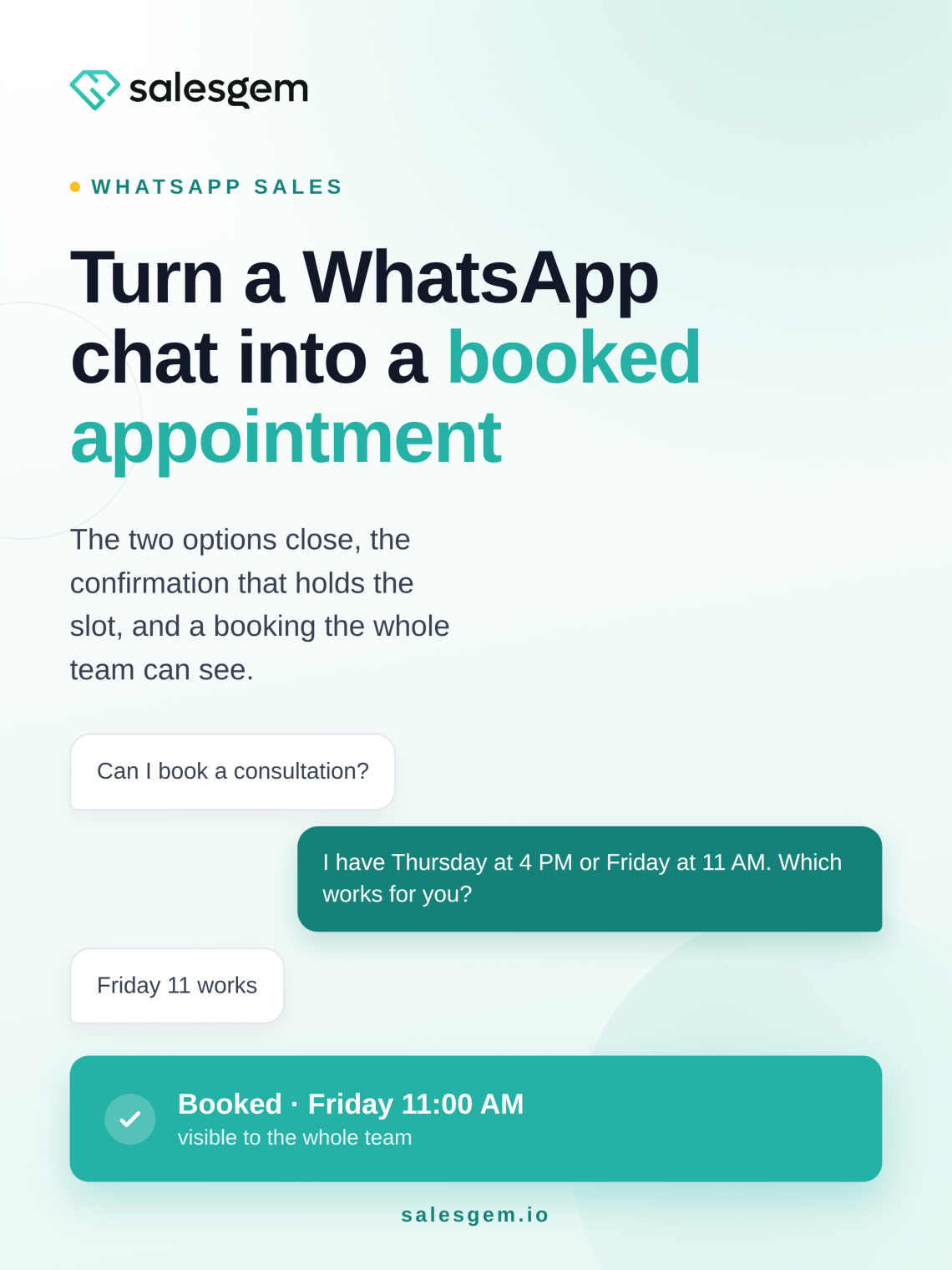
“I have Thursday at 4 PM or Friday at 11 AM. Which works for you?”
This is the assumptive slot offer, and it works because of how people make decisions. An open question asks the lead to do planning work. A two option question asks them to make one easy choice. Most people will pick one of the two, and the ones who cannot will tell you a third time that suits them, which is still a booking conversation rather than a dead one.
I keep three rules on this technique:
- Offer two real slots, not a vague “this week.” Precision signals that your time is organised and theirs should be too.
- Keep it to two. Three or more options turns an easy choice back into planning work.
- Offer the slots early, often right after the price or the first real question. Waiting for the lead to “warm up” usually means waiting for them to leave.
Say it, then confirm it
Getting a yes is not the same as getting a booking. That lesson came from a different company, where the reps had the opposite problem. They were good at getting people to agree. Too many of those agreements never turned into a visit.
A typical chat ended with “yes, I will come tomorrow.” The rep treated that as booked and moved to the next lead. There was no specific time, no reminder, and often the lead had no idea which staff member they would meet. When I reviewed the conversations behind our no shows, nearly all of them had the same shape: a soft yes, then silence.
So I changed what counted as a booking. A soft yes was not one. The rep had to pin it down.
“Great. Shall I reserve 5 PM tomorrow for you?”
Once the lead confirmed a specific slot, the appointment was recorded and the lead received a reminder before the visit. If they could not make it, the rep had a clear rescheduling step instead of letting the thread vanish. The confirmation does two jobs at once. It turns a vague intention into a commitment with a time attached, and it gives you something real to remind against later.
The booking that lives nowhere
Both teams had a second problem hiding underneath the first, and it is the one most managers miss.
When a lead said yes inside WhatsApp, the booking lived inside WhatsApp. The chat said “booked.” The team had no shared view of who was actually coming in. One rep knew. Nobody else did. If that rep was off, or busy, or had the conversation on a personal phone, the appointment was invisible to everyone who needed to plan around it.
I also ran into a handoff problem. The person chatting was often a telecaller, while someone else handled the appointment on site. All the useful context stayed trapped in the thread. By the time the customer arrived, the second person had to ask the same questions over again, which makes a keen lead feel like a stranger.
The booking has to exist somewhere the whole team can see, beyond one rep’s chat history. That is the difference between a conversation and a pipeline.
Measure the journey, not the chatter
The change that gave me the clearest view of performance was tracking stages separately instead of watching chat activity. On the first team I split it into three: interested, booked, attended. On the second I went further: enquiry, qualified, booked, confirmed, attended.
That breakdown is where the coaching lives. It showed me that some reps were excellent at starting chats but weak at asking for the appointment. Others booked well but never confirmed, so their no show rate was high. Chat activity hides all of that. It rewards the rep who sends the most messages, when the rep you actually want is the one who gets the most confirmed visits.
Once you can see each stage, you can fix the specific stage that is leaking instead of telling the whole team to “follow up better.”
How this plays out in different industries
The mechanics are the same everywhere, but the friction shows up in different places.
In aesthetic and healthcare clinics, the lead almost always wants a price before a consultation, and the honest answer is that the price depends on an assessment. Reps freeze there. The two option close gives them a way out: you move the conversation to a consultation slot rather than negotiating a number in chat. For out of town patients, confirming the exact day matters even more, because they are planning travel around it.
In coaching and education, two people often have to agree on the time, usually a parent and a student. A soft yes from one is not a booking. Pinning a specific slot that both can attend is the real commitment.
In solar and home services, the appointment is a site visit, so the rep needs an address and a time window before anyone drives anywhere. The two option offer works, but it is an offer of survey windows, not office slots.
In dealerships, the opener is almost always “on road price?” and the lead is messaging three dealers at once. Speed to a booked test drive is the whole game, because the first dealer to get them into the showroom usually wins.
Different pressures, same discipline. Offer specific slots, confirm the exact time, and record the booking where the team can see it.
What I tell every team now
After enough of these, the advice I give has shrunk to three things.
First, give the lead a next step, not a question. Your job is to make saying yes to a time easier than thinking about it. Two slots, early.
Second, confirm the commitment out loud. “Shall I reserve 5 PM for you?” is the sentence that turns a maybe into a booking you can hold someone to.
Third, get the booking out of the chat and in front of the team. A lead management system that captures the WhatsApp enquiry, assigns an owner, and shows every booked and confirmed appointment in one place is what stops good conversations from quietly disappearing. This is the gap Salesgem is built to close, by keeping the enquiry, the owner, and the booking stage visible to the whole team instead of locked in one rep’s phone.
A chat that keeps going still counts for nothing on its own. The win arrives when it reaches a confirmed appointment that the whole team can see.
Frequently asked questions
Moving a WhatsApp chat to a booked appointment means ending the conversation with a specific, confirmed time rather than an open plan. Offer the lead two exact slots, ask them to pick one, then confirm the date and time in writing. Record the booking somewhere the whole team can see it, rather than leaving it in the chat thread.
The two options close is offering a lead two specific appointment slots instead of asking when they are free. For example, “I have Thursday at 4 PM or Friday at 11 AM, which works for you?” It converts better than an open question because it asks the lead to make one easy choice rather than do their own planning.
WhatsApp leads often give a soft yes, like “I will come tomorrow,” that was never tied to a specific time. Without a confirmed slot and a reminder, that intention fades. Counting a booking only after the lead confirms an exact time, then sending a reminder before the visit, cuts the no show rate.
It depends on the business. Where the price is fixed, sending it quickly builds trust. Where the price depends on an assessment, as in most clinics, sending a number in chat invites haggling and stalls. In those cases, move the conversation to a booked consultation instead of negotiating the figure over text.
Track WhatsApp lead conversion by stages rather than chat activity. A simple version is interested, booked, attended. A fuller version is enquiry, qualified, booked, confirmed, attended. Watching each stage separately shows you exactly where leads drop off, so you can coach the specific weak point instead of asking the team to follow up more.