Yes, multiple sales reps can use one WhatsApp number. There are two ways to do it. The free WhatsApp Business app links one number to a primary phone and up to four extra devices, so a small team can share access. For a real sales team that needs lead ownership and dependable follow-up, you connect that number to the WhatsApp Business API through a CRM with WhatsApp integration, which assigns each lead to a named rep and records the reply.
I learned the difference between those two answers the hard way.
I have spent more than ten years consulting with sales teams across clinics, coaching, solar, and property firms. In conversation with sales reps and managers almost every day, and the same question shows up in nearly every business that runs ads on Facebook, Instagram, or WhatsApp. One number, several people, and no clear idea who is doing what. Let me walk you through what I have seen, because the habits a shared number creates matter far more than the setup itself.
The clinic that shared one number between three coordinators
A few years ago I was managing the sales side of a clinic. Three coordinators shared one WhatsApp Business number to handle appointment inquiries. On paper it looked practical. Everyone could see every incoming message, so I assumed leads would get answered faster.
What actually happened was two different failures, and they took turns.
Sometimes two coordinators replied to the same patient. One quoted a consultation fee, the other quoted a different slot, and the patient read both. Other times nobody replied at all, because each coordinator assumed one of the others had already picked it up.
I only found out how often this was happening when I sat down and read through the chats with the team. I had no clear lead ownership. So i could not tell who had handled which conversation. I had no reliable record of response times. The patient saw a clinic that looked disorganized, and I had no data to decide who on my team needed coaching.
Here is what that taught me. Giving everyone access to one WhatsApp number does not mean everyone is managing leads. What we needed was a shared inbox with automatic lead assignment, clear ownership, and reply tracking. More linked devices would not have fixed any of it.
A shared number solves access, not follow up
At another company, my reps were answering new WhatsApp inquiries, and we were still losing bookings. That one confused me for a while, so I went back through the conversations.
The pattern was simple once I saw it. A rep would answer the first question about pricing or services, then wait for the prospect to come back. Nobody owned the next step. One rep expected the front desk to follow up. Another assumed the prospect would message again when they were ready. Because every follow up depended on someone remembering, interested prospects got one reply and were then forgotten. Some of them booked with a competitor before we ever circled back.
It got worse during busy hours. When a rep was holding several conversations at once, the chats could sit open on different devices, but there was no dependable way to track which replies were pending or which lead needed attention next.
What I learned that time: a shared number solves access, not follow-up. I needed assigned owners, reminders on conversations that had gone quiet, internal notes so one rep could brief another, and a clear view of which leads had been left untouched.
That is the point where a CRM connected to the WhatsApp Business Platform (API) earns its place. WhatsApp gives you the conversation. The CRM adds the ownership, the lead follow-up discipline, and the reporting that turns those conversations into appointments.
The two real ways to share one WhatsApp number
Since this question comes up so often, here is the honest version of the “how,” because the two methods are not close substitutes.
Option one: the WhatsApp Business app
The free WhatsApp Business app lets you link one account to a primary phone plus up to four companion devices. Meta Verified, the paid tier, raises that to nine companion devices. Your reps log into the same account from their own phones or a browser, and everyone sees the same chats.
This is fine for a solo owner or a two person counter. The ceiling is not really the device count. It is that the app was built for one person on several screens, not several people working one number. There is no lead assignment, no note that says a chat belongs to a specific rep, no record of who replied, and no follow-up reminders. During a busy week, that gap is exactly where bookings leak.
Option two: the WhatsApp Business API with a CRM
The WhatsApp Business API removes the device limit and the shared login. The number lives in the cloud, and any number of reps can work it from their own account inside a shared inbox. This is where a real sales setup becomes possible, because the API is what lets software sit on top of your number and organize the work.
On its own, the API is just a pipe. Connect it to a CRM and you get the part a sales manager actually needs. Each lead is assigned to one owner. Response times are visible. Internal notes stay attached to the conversation. Quiet threads get a reminder before they go cold.
Where this problem hits hardest, by industry
The teams that feel this most are the ones where a single inquiry is worth a lot and a slow reply is expensive. From the clients I work with, four stand out.
Clinics and aesthetic practices live on appointment inquiries, and those messages are personal. A patient asking about a procedure and a price will not wait long, and a dropped chat is a booking that quietly went to the clinic down the road.
Coaching and education teams get flooded during admission windows, often with parents messaging late at night. Two counsellors answering the same family looks careless at the exact moment a parent is deciding whether to trust you, and most of these decisions need several follow-ups over weeks.
Solar companies sell a considered, high value purchase with a long cycle. Field staff and office staff need the same thread, and a quote request that sits unassigned while a rep is on a rooftop is a quote that goes cold.
Property teams run on speed. The first agent to respond usually gets the viewing, so a shared number with collisions and dropped messages is close to the worst setup you can choose.
The thread running through all four is the same. High intent, high value, and time sensitive, landing on a number that several people share with nothing underneath it.
Does a CRM actually play a role here? Yes, it is the fix
When people ask me whether a CRM is worth it for WhatsApp, I tell them the API and the CRM do two different jobs. The API is the plumbing that lets many reps work one number. The CRM is the part that decides who gets which lead, when, and whether they followed up.
A CRM built for this does a few specific things the app cannot. It assigns every new lead to one named rep, so there is always an owner and never a scramble. It tracks who replied and how fast, so you can coach the slow rep instead of guessing. So it holds internal notes on each conversation, so a handover keeps its context. And it reminds a rep when a thread has gone quiet, so follow-up stops depending on memory.
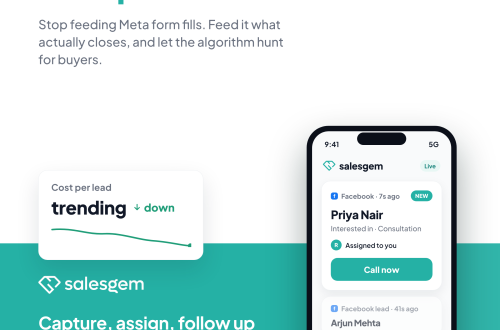
This is the gap Salesgem was built to close. It captures Facebook and Instagram lead ads alongside WhatsApp inquiries into one place on the official WhatsApp Business API, routes each lead to the assigned rep instantly, and keeps the lead management and follow up on track, so one shared number stops behaving like a free for all. If you want to see it against your own lead flow, you can Sign Up and connect a number. No credit card needed · 14 day free trial · Free support and migration.
My advice after ten years of watching this go wrong
If I could give a sales manager one piece of advice here, it would be this. Decide the ownership rule before you add the technology.
Sharing a number is an access decision. Converting the leads on that number is an ownership decision, and those are not the same problem. The teams that win on WhatsApp are not the ones with the most devices logged in. They are the ones where every lead has a name next to it, every slow reply is visible, and no conversation depends on someone happening to remember it.
Start with the question “who owns this lead, and what is the next step.” Then pick the setup that answers it. For a solo shop, the app is enough. For a team that is losing bookings it cannot explain, move the number onto the WhatsApp Business API and put a CRM with WhatsApp integration behind it. The conversations were never the problem. The missing owner was.
Frequently asked questions
Yes, multiple users can use the same WhatsApp Business number. On the free WhatsApp Business app, one primary phone links to up to four companion devices, so a small team shares one account. For a larger sales team, the WhatsApp Business API removes that limit and lets any number of reps work the same number inside a shared inbox with proper lead assignment.
One WhatsApp Business account on the free app runs on a primary phone plus up to four linked devices, which is five surfaces in total. The paid Meta Verified tier raises this to one phone and nine companion devices. The WhatsApp Business API has no device limit, because the number runs in the cloud rather than on a single primary phone.
The difference is management, not messaging. The WhatsApp Business app lets several people see one number, but it has no lead assignment, no record of who replied, and no follow-up reminders. The WhatsApp Business API lets a CRM sit on top of the number and add owners, response tracking, internal notes, and reminders, which is what a sales team needs to convert.
You assign WhatsApp leads to specific reps by connecting the number to the WhatsApp Business API through a CRM. The CRM routes each incoming lead to one owner automatically, records who is responsible, and flags conversations that have gone quiet. The free WhatsApp Business app cannot do this, because it has no concept of lead ownership built in.
Yes, a CRM works with one shared WhatsApp number when that number is connected through the WhatsApp Business API. The CRM becomes the shared inbox, assigns each lead to a rep, tracks response times, and keeps the follow-up on schedule. Salesgem does this while also capturing Facebook and Instagram lead ads into the same place.