I have spent more than a decade managing sales teams that live off Facebook and Instagram leads. I have done it across clinics, education brands, and home service companies. The pattern repeats everywhere I go. A business proudly reports a falling cost per lead, then asks why sales still is not improving. The fix almost always comes down to one habit. Feed the Meta Conversions API real CRM data, not just the raw form fill. Meta only knows what you tell it.
Receiving a lead is not the same as owning a lead
Early in my career I ran a team where every Facebook inquiry dropped straight into a shared inbox. Every rep could see every lead, which sounded efficient at the time. In practice, everyone assumed someone else would make the first call. When I finally pulled the records, some leads had sat untouched for hours before anyone picked up the phone.
The fix was not complicated. We moved to a CRM that assigned each Facebook inquiry automatically, using round robin rules, branch, or product interest. From the moment a lead arrived, it had one named owner. The CRM also logged assignment time, first response time, and any lead that sat overdue without contact. For the first time, I could see exactly who was moving fast and where leads were stalling. No more guessing from gut feel at the end of the month.
That ownership record turned out to be the foundation for everything that came later. It is how we eventually connected our CRM to Meta through a Facebook Conversions API CRM integration. Meta cannot learn from a lead your team never properly worked in the first place.
How the Meta Conversions API changes what Meta sees
By default, a Facebook or Instagram lead form sends Meta exactly one signal, a form submission. Meta’s advertising system treats that submission as the goal. It spends your budget finding more people who look likely to submit a form. It has no way of knowing which submissions were real. A share of them were wrong numbers, duplicate entries, or people who were never going to buy. This is the gap the Meta Conversions API is built to close.
This is the plain language version of what Meta calls event match quality. Every time you send Meta a piece of information about a lead, that event gets scored. The information could be an email, a phone number, a qualified lead, or a closed deal. Meta scores how confidently it can match that information back to a real account. More matched information means Meta can learn from the outcome. Less means the event barely counts toward anything.
Before and after: what changes once the data flows back
Before, with no downstream data flowing back:
- Meta sees a form filled
- Meta optimizes toward more form fills
- Fit and quality never enter the equation
After, once the CRM feeds stages back through the Meta Conversions API:
- Meta sees a lead, then a qualified lead, then a booked appointment, then a closed deal
- Meta starts optimizing toward people who resemble your closed deals, not just people likely to tap a form
- Budget shifts away from the audiences that only ever submit and never buy
The size of that shift depends on the business. Meta’s own published case studies still give a sense of it. One Meta training case study was built around a business called TECOBI. TECOBI switched from optimizing for lead volume to optimizing for conversion leads, fed by CRM data through the Conversions API. The result was a 68 percent higher conversion rate. Cost per qualified lead fell 8 percent, compared with optimizing for lead volume alone. Other figures published by Meta partners run higher, into the high teens and twenties. That range tells you something important. The result depends heavily on how clean and complete your CRM data is before it goes back.
A lower cost per lead that did not mean a better month
I have watched teams celebrate a falling Facebook cost per lead. At the same time, sales quietly struggled to turn those same leads into paying customers. It became obvious once I put the ad reports next to the sales pipeline side by side. Reps were logging calls in one place and deal outcomes in another. Almost none of it made its way back into a single reliable record. Meta kept receiving the same signal it always had, a form submission, and kept optimizing for exactly that.
The fix was to connect three things that are usually kept apart. Facebook lead ads, sales assignment, and conversion tracking, all inside one CRM. New leads were assigned automatically the moment they arrived. The CRM then tracked every stage after that: first contact, qualified lead, booked appointment, closed deal. Where it was supported, those outcomes were sent back through the Meta Conversions API. The algorithm finally learned from what happened after the form, not only from the form itself. For clinics on our client list, this was the difference between a booked consultation and one that was actually attended. A raw lead count will always treat those two outcomes as identical.
Here is the lesson I took from that stretch of my career. Automatic assignment is not only about splitting leads evenly across a team. Paired with a CRM that connects to Meta, it gives every lead an owner. It also shows you how fast your team responds, and ties sales outcomes back to the campaign that produced them. Without that full loop, you can spend less per lead and still lose the deals that actually mattered.
What this looks like across the industries I have worked in
Clinics and aesthetic practices usually run a funnel with several real gates: inquiry, consultation booked, consultation attended, procedure booked, payment. A raw lead treats someone who asked a question the same as someone who paid. Once booked and attended become separate events in the CRM, something changes. A clinic manager can finally see which campaigns bring people who show up, not just people who ask.
Education and coaching businesses face a longer gap between the lead and the sale. It is often weeks between a webinar registration and an actual enrollment. That enrollment usually closes over a call, not on the platform itself. If that enrollment never gets reported back, Meta works from old information. By the time it reaches a decision, that information is already out of date.
Solar sales run through several qualifying gates before a contract is signed: homeownership, roof condition, financing approval. A large share of raw leads fail one of those gates. Feeding disqualified back to the CRM matters as much as feeding qualified. Otherwise the algorithm keeps sourcing more of the leads that were never going to qualify in the first place.
What I would tell any sales manager starting this today
- Give every lead a named owner the moment it arrives. A shared inbox is not a system.
- Track response time and overdue follow up the same way you track revenue. What gets measured gets worked.
- Decide what counts as a qualified lead before you connect anything to Meta. A vague signal is barely better than no signal at all.
- Send stages back, not just leads. Qualified, booked, and closed each teach the Meta Conversions API something different.
- Check how long your sales cycle actually runs against the window Meta uses to judge a conversion. A slow cycle and a short window will always look worse on paper than it really is.
- Treat CRM data entry as a sales habit, not an afterthought. The feedback loop is only as good as what your team actually logs.
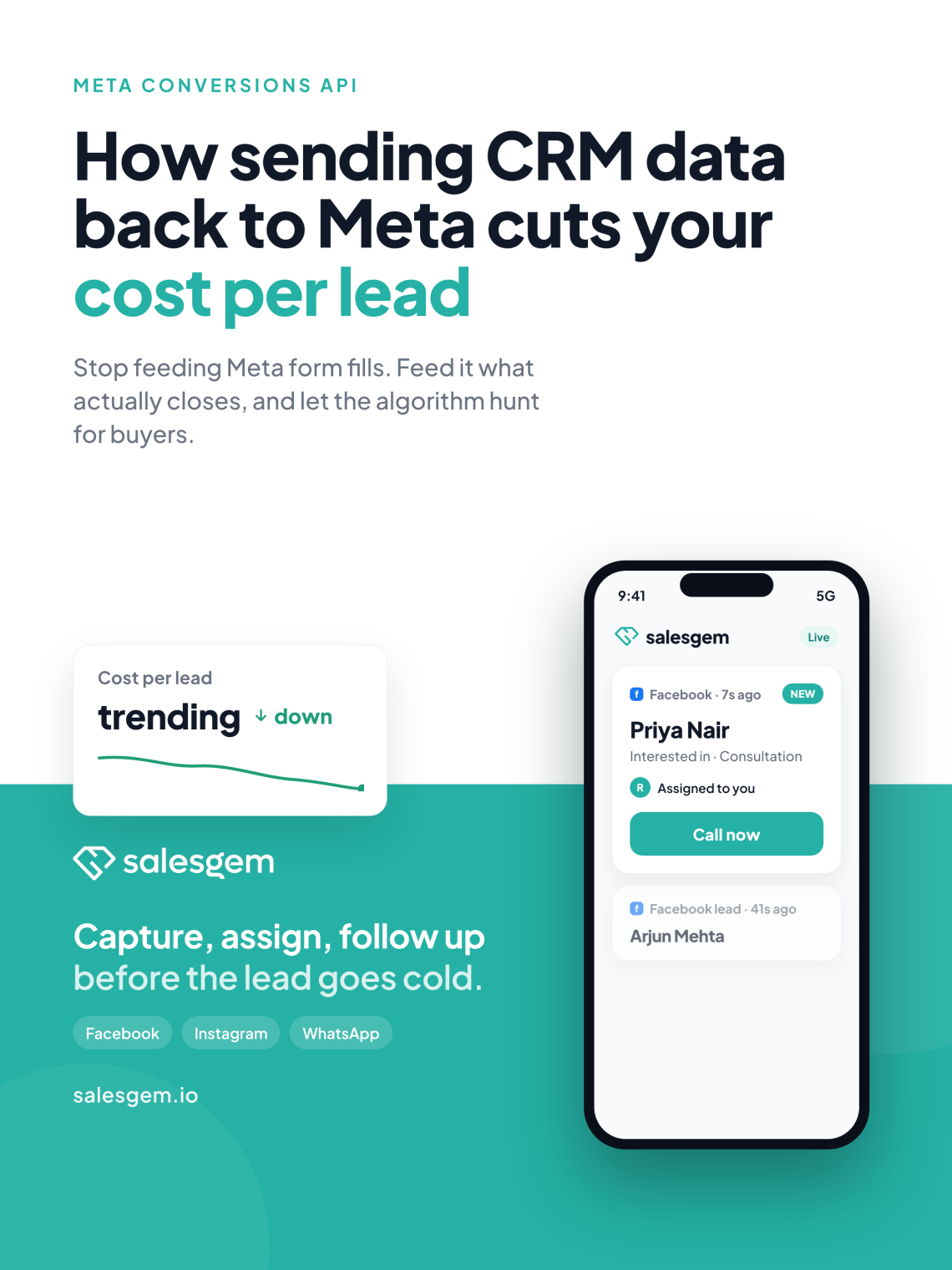
None of this requires a developer or a second system for your team to fight with. Salesgem captures Facebook, Instagram, and WhatsApp leads, and assigns them automatically. It also connects the stages your reps already work through to the Meta Conversions API. Get Facebook and Instagram leads on your phone instantly. Call them before your competitor does.
Sign Up at salesgem.io. No credit card needed, 14 day free trial, and free support and migration. That covers you if you are moving off a spreadsheet or another tool.
Frequently asked questions
The Meta Conversions API sends information from your own systems, like a CRM, directly to Meta’s servers. It lets Meta learn from outcomes after the lead form, like a qualified lead or a closed deal. That is more than just the form submission itself. Over time, Meta uses that fuller picture to find more people like your actual customers. That is what tends to bring cost per lead down.
The Meta Conversions API itself is free to use. The cost, if any, comes from the CRM or connection tool you use to send the data, not from Meta. A CRM with the integration already built in removes one headache. You do not need to pay a developer to build and maintain the connection separately.
Results vary by business and by how much volume you run. Meta generally needs a steady flow of conversion events each week to optimize properly. Low volume accounts take longer to show a clear shift than high volume ones. Expect weeks, not days, before the pattern becomes reliable.
The Meta Conversions API sends hashed identifiers, not raw personal data. Meta never receives a readable email address, phone number, or name. Clinics and other businesses handling sensitive information should still decide deliberately what gets sent. Confirm it fits their own compliance requirements before turning the connection on.
The same thinking applies anywhere a lead moves through a CRM with a clear stage for qualified, booked, or closed. Salesgem captures Facebook, Instagram, and WhatsApp leads inside one system. Outcomes from a WhatsApp conversation can feed the same feedback loop as a Facebook lead form.
Sending Meta a vague or inconsistent signal. A lead marked qualified by one rep and ignored by another teaches the Meta Conversions API nothing useful. Agree on what qualified, booked, and closed actually mean across the whole team before connecting anything. Otherwise the data going back will be as unreliable as the data you started with.