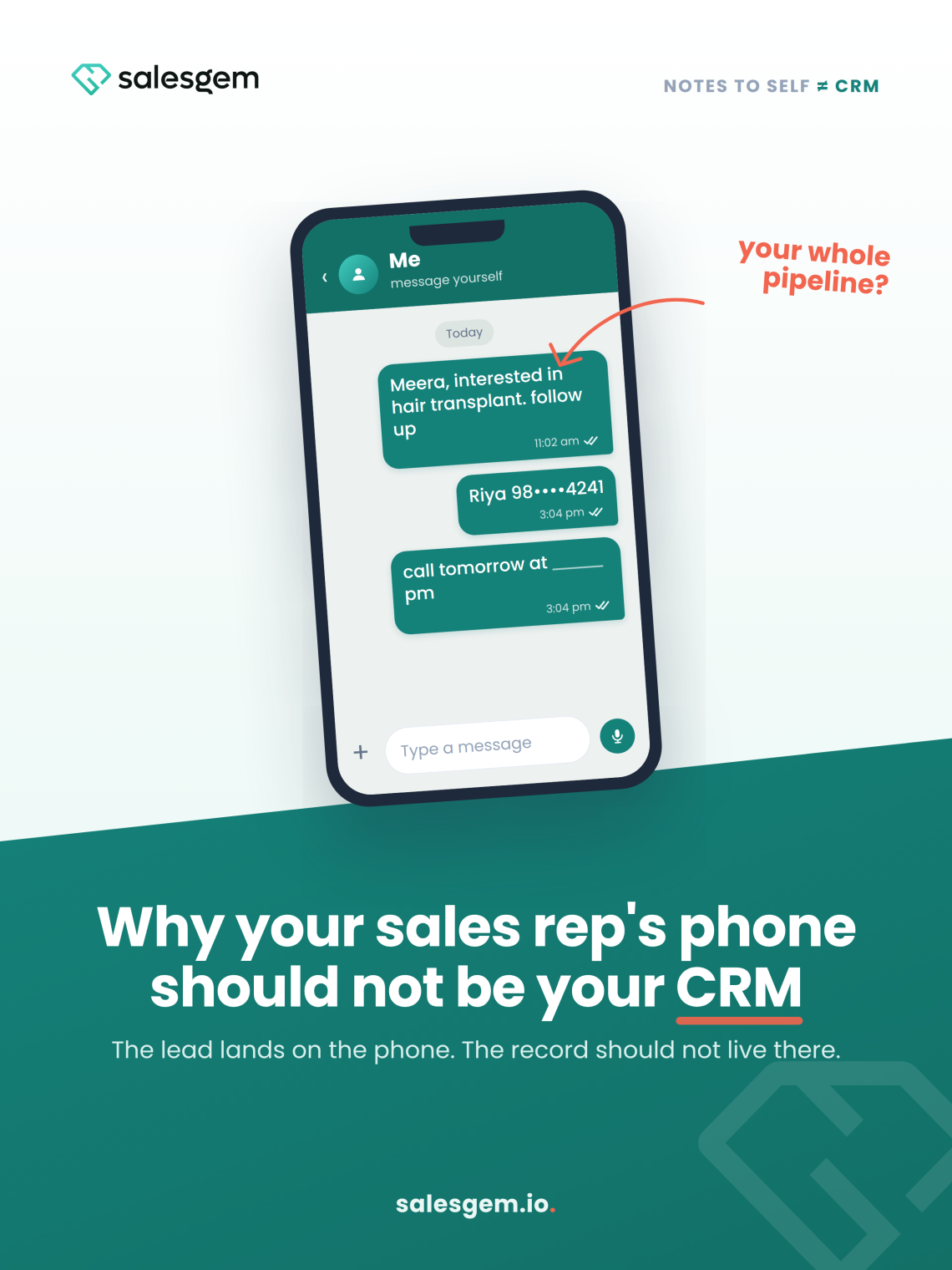
A phone as a CRM feels organized until the rep who owns it walks out. I have managed sales teams across clinics, car dealerships, and coaching businesses. Everywhere I go, I see the same setup. The phone is where a lead should land and where a rep should act. It should never be the only place your customer history lives.
Most small teams drift into this by accident. Leads come in from Facebook and Instagram ads. A rep saves the contact, chats on WhatsApp, and keeps the callback date in his head. The sales leaders I trade notes with describe the exact same mess. If you want the deeper fix, start with a proper lead follow up CRM for small business rather than a pile of phones.
Here is the risk in one line. Your contacts, your chats, and your deal history sit on a device the company does not control. In B2C sales, where buyers decide fast, that gap gets expensive quickly.
The day a phone as a CRM left us with nothing
One rep on my team had handled Facebook ad leads for months. Every detail lived on his phone. WhatsApp threads, call notes, demo dates, and saved reminders in his contacts. From where he sat, everything looked organized.
Then he left the company.
I asked for the status of his active leads. There was no pipeline to hand over. We had to dig through his phone, his chats, screenshots, and his memory. We tried to work out who had already spoken to us, who had a demo booked, and who was close to buying.
Some follow ups got missed. A few customers had to repeat their whole story to a new rep. That looks bad, and it costs money.
We had not lost the leads when he left. We lost the record of every relationship, because that record lived only on his personal phone.
That was my lesson. A phone should be where the lead lands and where the rep works. It should never be the only home for your customer history.
The follow up that slipped through the cracks
Another case was simpler and just as expensive. A rep got a new lead and called the customer. The customer was not ready to book that day. So the rep said he would call back on Thursday.
Thursday came. The rep was buried in other calls, and he forgot.
There was no task in a system. No manager alert. No pipeline showing that this customer was waiting. The only trace was one WhatsApp thread, lost inside hundreds of messages.
Weeks later I asked about the lead. The rep scrolled his chats and said, “Oh yes, I remember this one. I will call them.” By then the customer had already bought elsewhere.
This is the part managers miss. Having the conversation on the phone is fine. Losing the business history on the phone is what kills the deal.
A phone is great for calling, messaging, and acting fast. Follow ups, scheduled calls, demos, and notes need to live in a system the whole team can see. Speed is part of it too. How quickly you respond to a new Facebook lead often decides the deal before the record ever matters.
The personal WhatsApp trap most small teams fall into
Here is how the trap forms. WhatsApp is already on every rep’s phone. Leads message there, so reps reply there. Slowly, WhatsApp becomes the lead database, the notes app, and the follow up reminder, all at once.
It feels efficient. It is not.
The chats sit on personal accounts. The manager cannot see them. When a rep is off sick, nobody can pick up his conversations. When a rep quits, the account leaves with him, and so does every lead inside it.
There is a quieter cost too. Personal phones mix family chats, group jokes, and hot leads in one feed. Real buyers get buried. The rep is not lazy. The tool is just wrong for the job.
I keep the phone for what it is good at. I move the record into a shared system the whole team can open.
Industries where a phone as a CRM hurts the most
I see this pain sharpest in a few types of business. The pattern is always high lead volume, several reps, and staff who move on.
Aesthetic and healthcare clinics feel it first. A coordinator handles consultation inquiries on one phone. Each inquiry is high value, and the data is sensitive. When that person leaves, the inquiry history leaves too.
Car dealerships live the same story. Many salespeople, fast turnover, and online leads mixing with walk ins. The customer list leaving with a rep is almost a running joke there.
Solar and home services run long quotes over many weeks. Memory based follow up simply cannot hold that timeline. A stalled quote just goes quiet.
Coaching and education chase parents and students inside tight enrollment windows. One counselor leaving mid season can take a whole intake with him.
Insurance and financial teams carry a compliance weight on top. They need a clear record of what was said and agreed. A personal chat thread is not that record.
What I tell every sales manager now
My advice is short, because the fix is not complicated.
First, split the two jobs. Let the phone be where reps call and message. Keep the record of every lead in a system the whole team can see.
Second, turn follow ups into tasks, not memories. A callback with no task attached is a callback that will get missed.
Third, own the data at the company, not on the device. If a rep leaves on Friday, the pipeline should still be there on Monday.
This is the quiet win most managers underrate. It is not a flashy feature. It is plain visibility. You can see what came in, who owns it, and what is stuck.
This is where a tool like Salesgem fits for a small team. It captures your Facebook, Instagram, and WhatsApp leads, assigns each one to a rep, and keeps the full history in a pipeline you can see. The lead still lands on the phone. The record just stops living there. You can see how the follow up side works and Sign Up when you want to try it.
No credit card needed. 14 day free trial. Free support and migration.
Frequently asked questions
A sales rep’s phone should not be the CRM because the record then lives on a personal device the company cannot see or control. Chats, contacts, and follow up dates stay locked to one person. When that rep leaves or is unavailable, the lead history goes with them. The phone is for acting on leads, not storing the business record.
When a sales rep leaves and the leads lived only on their phone, the company usually loses the relationship history. Contacts, WhatsApp threads, demo dates, and callback notes disappear with the device. The team is left rebuilding each lead from memory and screenshots. A shared pipeline prevents this, because the record stays with the company, not the person.
WhatsApp is a great channel for talking to leads, but it is a poor CRM. Conversations sit on personal accounts a manager cannot view. There are no tasks, no assignment rules, and no pipeline. For a small team, WhatsApp works best as a messaging channel that feeds into a real system, not as the system itself.
The customer record should live in the CRM. That means every lead, its source, the assigned rep, follow up tasks, scheduled demos, call notes, and stage in the pipeline. The phone stays useful for calling and messaging. The CRM holds the history so any team member can pick up a lead without starting from zero.