Lead response time is the gap between a form submission and your first real contact attempt. A Lead Connect survey found that 78% of customers buy from the business that responds first. Speed, in other words, often settles the deal before the pitch begins. I have watched that happen on sales floors for over ten years.
I work as a sales consultant. Over the last decade I have sat with clinics, coaching centres, solar installers, home service crews, and car dealerships. Different products, different price points, same bottleneck every time. If you want the underlying framework rather than the war stories, start with our guide to lead follow up CRM for small business.
What follows is what I actually saw, and what I changed.
The campaign that looked great on paper
A few years ago I managed a sales team pulling in more than 100 Facebook leads a day.
The campaign looked healthy from every angle. Cost per lead was low. Volume was steady. The monthly report was a pleasure to present.
Then I opened the conversion numbers. They were poor.
Everyone on the team had a theory. The leads were junk. The audience was wrong. The offer needed rewriting. Those explanations are comfortable because they point away from the sales floor.
None of them survived once I traced a single lead from start to finish.
What actually happened after someone submitted the form
So I followed one lead through its whole journey.
The lead landed in Meta Lead Center and stayed there. Somebody had to remember to check. A manager then opened the file and assigned it to a rep. The rep called once they finished the call they were already on.
Sometimes that sequence took 30 minutes. Often it took longer. On a busy afternoon it stretched past an hour.
Meanwhile the prospect had filled in forms for two or three other businesses. Meta instant forms make that effortless. One tap and the details are already sent.
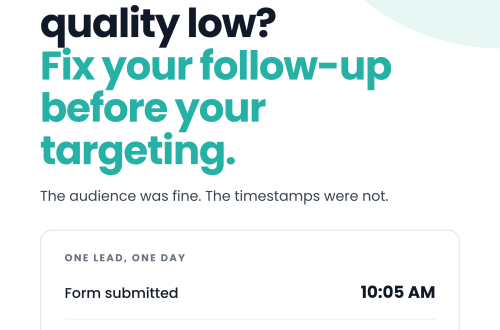
By the time my rep dialled, someone else had opened the conversation. My rep was then arguing against a decision the prospect had half made. I unpacked that problem in why your Facebook leads feel low quality.
The one change that moved lead response time
I changed one thing.
I connected the lead source directly to a CRM and automated the handoff. From that point, every new lead arrived in the CRM the moment it was submitted. The system assigned it to the right rep automatically. The rep got an alert on their phone straight away.
The alert carried context, which mattered more than I expected. Campaign name, enquiry details, and contact number were all visible before the rep dialled.
Response time dropped from tens of minutes to a few minutes.
My reps sold exactly the way they always had. The only difference was that they reached more prospects before anyone else did. Conversions moved on the back of that single change.
The real problem was ownership
Speed was only half of what I fixed. The bigger problem was ownership.
A new Facebook enquiry would land in a shared inbox while three reps were on calls. Each of them assumed a colleague would take it. Nobody did. We noticed an hour later, after the prospect had already spoken to another business.
It wasn’t that my reps were slow. Nobody clearly owned the lead.
CRM automation closed that gap. Every lead went to a named rep automatically, with an immediate notification and a follow-up task attached. If the rep did not act inside the agreed response window, I could see it on my screen and reassign.
That gave us accountability alongside speed.
Telling a team to call faster achieves very little. The system has to deliver the lead to the right person, make ownership visible, and flag anything sitting untouched. Automatic lead assignment is the part most teams skip.
What lead response time looks like in different industries
I have run this exercise across several verticals. The bottleneck changes shape. It never disappears.
In aesthetic and healthcare clinics, the front desk owns the enquiry. That same person is checking in patients and answering the landline. Evening enquiries pile up after the desk closes. By morning the patient has messaged three clinics about the same procedure.
In coaching and education, enquiries spike at night when students are free. Batch deadlines make every hour before admissions close worth more than the last. Counsellors work in shifts, so context gets lost at handover.
In solar, the first response is really a data gathering call about the roof and the electricity bill. Homeowners request quotes from several installers on the same afternoon. Whoever books the site survey first usually keeps the job.
In home services, intent is urgent and the technician is already on a job. Whoever picks up gets the work.
In dealerships, showroom traffic outranks the digital enquiry. The lead sits in a system nobody checks hourly.
Five industries, one pattern. The lead arrives faster than the organisation can react to it.
What the research says about lead response time
The 78% figure deserves careful handling. It comes from a Lead Connect survey and it travels widely across vendor blogs. I have seen it credited to MIT and to Harvard Business Review, which is wrong. Treat it as a directional signal from one survey.
The better anchored numbers are older.
James Oldroyd ran the Lead Response Management Study through MIT and InsideSales.com in 2007. Contacting a lead within five minutes made a team 21 times more likely to qualify it. The comparison point was a 30 minute response.
Harvard Business Review published its own analysis in 2011 across 2.24 million leads. Firms attempting contact within an hour were close to seven times more likely to qualify a lead. The comparison group waited a single hour longer.
Both studies predate Facebook Lead Ads at scale. My own view is that the gap has widened since. An instant form lets a buyer enquire with five businesses inside a minute, and none of those businesses know about the other four.
How to shorten lead response time in your team
Here is the sequence I use with clients now. It takes about a week.
- Measure first touch, not first activity. Log the timestamp of the actual dial or message, then find your median. Most teams guess ten minutes and discover an hour.
- Define what counts as a response. Pick one: a dial attempt, a connected call, or a reply received. Ambiguity here hides the problem.
- Assign automatically. Manual assignment adds a human delay to every single lead, and that delay is where the sale goes.
- Push the alert to the phone. Email is where leads go to wait. Reps do not sit in an inbox during selling hours.
- Put context in the alert. Campaign, form answers, and phone number, all before the rep dials. A cold opener wastes a fast response.
- Set an escalation window. If nobody touches the lead inside it, the manager sees it and reassigns.
- Cover the hours your ads run. Campaigns work through evenings and weekends. Decide who handles that, or pause the ads.
Salesgem was built for this exact workflow. It captures Facebook, Instagram, and WhatsApp leads in real time. Each lead goes to a named rep, who gets a phone alert with the enquiry details attached. You can Sign Up and connect a live campaign the same day.
No credit card needed · 14-day free trial · Free support and migration
What I tell sales managers now
If I could hand a sales manager one instruction, it would be this. Stop debating lead quality until you know your response time.
Almost every team I meet believes it responds within ten minutes. When we measure properly, the median sits closer to an hour. The belief and the data rarely match, and the gap between them is usually where the quarter was lost.
Fix the routing before you fix the script. A rep with an average pitch who calls in two minutes will beat a strong rep who calls at forty. I have watched that happen too often to treat it as an accident.
There is a second lesson I would add. Ownership beats effort. Three willing reps and no assignment rule will lose to one rep with a clear queue, every time.
Businesses that respond first usually buy the same leads as everyone else. What they own is a system that gets those leads to a named person immediately, and a manager who can see when that fails.
Build the system. The conversations follow. For the wider picture on cadence and follow-up structure, our lead follow up CRM for small business guide covers what comes after the first call. Meta Lead Center compared to a real CRM covers where most of this delay starts.
Frequently asked questions
What is a good lead response time for Facebook leads?
A good lead response time for Facebook leads is under five minutes, measured from form submission to your first dial or message. The MIT and InsideSales research from 2007 found a 21 times higher qualification rate at five minutes compared with 30 minutes. Anything past an hour puts you behind competitors who received the same enquiry.
Do 78% of customers really buy from the business that responds first?
The 78% figure comes from a Lead Connect survey rather than an academic study, so treat it as directional. It is frequently misattributed to MIT or Harvard Business Review. The underlying pattern holds up in better sourced research, though. Faster first contact raises qualification rates sharply, and buyers who are already talking to someone rarely restart the process.
Why do leads from Meta Lead Center get answered so slowly?
Leads in Meta Lead Center sit still until a person opens the tool and looks. There is no automatic assignment, no push alert to a rep’s phone, and no escalation when a lead goes untouched. Teams usually add a manual download and a manual handoff on top. Each step adds minutes the prospect spends elsewhere.
How does a CRM improve lead response time?
A CRM improves lead response time by removing the human steps between the form and the phone call. The lead arrives automatically, gets assigned to a named rep by rule, and triggers an alert with the enquiry details attached. Managers also get a visible record of who touched what and when, which makes slow follow-up correctable.
Should reps call or message a new Facebook lead first?
Call first, then message if the call goes unanswered. Facebook Lead Ads capture a phone number and buyers who filled a form minutes ago usually expect contact. A WhatsApp message immediately afterwards gives them a low effort way to reply. Sending only a message and waiting is the most common reason a fast response still fails to convert.