I have spent more than ten years helping sales teams turn raw enquiries into booked appointments, across clinics, solar installers, and coaching businesses. The fastest way I have found to qualify leads fast is to ask five questions in a fixed order, and the first two sort buyers from browsers in under a minute. What follows is the exact framework I hand my clients, with the industry quirks that decide how you use it.
A busy lead list is not a good lead list
Most of the owners I work with already know speed matters. What they miss is that a quick lead follow-up process for small business only pays off when that speed lands on the right people.
When I was managing the sales follow-up for a run of aesthetic clinic campaigns, one pattern became clear fast. A full lead list did not mean more consultations. Plenty of people enquired about hair transplants just to compare prices. At the same time, some genuine prospects got dismissed too early, because the reps had waded through so many casual enquiries that day that everyone started to look the same.
So I changed the order of the conversation. Instead of pitching, the reps opened with two questions. “What’s got you looking into this now?” and “Are you looking to get this sorted this month, or gathering information for later?” If the answers showed real intent, the rep went deeper: how long the problem had been on their mind, who else influenced the decision, and whether they had thought about the likely cost.
The lesson stuck with me. Train reps to qualify before they chase, but never write off a lead on a single answer. Record the responses, set the follow-up task, and keep consultation-ready prospects separate from the ones who still need time. And leave medical suitability to the clinic’s qualified professionals, because that is a clinical call, not a sales one.
The two questions that do most of the sorting
Those first two questions carry most of the weight, so it helps to know why.
The trigger question, “what’s got you looking into this now?”, finds the reason behind the enquiry. A buyer usually has one that started this week. A tooth cracked. The electricity bill jumped. The course deadline is close. A browser has no “now,” and you will hear it in the pause before they answer.
The timeline question, “are you looking to get this sorted this month, or gathering information for later?”, gives the person permission to say “just looking.” Most will take it, which saves you days of polite chasing. In consumer sales, timeline is the cleanest line between a buyer and a browser you will find.
The five questions I use to qualify leads fast
Once the first two questions earn a green light, I run the full set. Here is the order, with what each one is actually measuring.
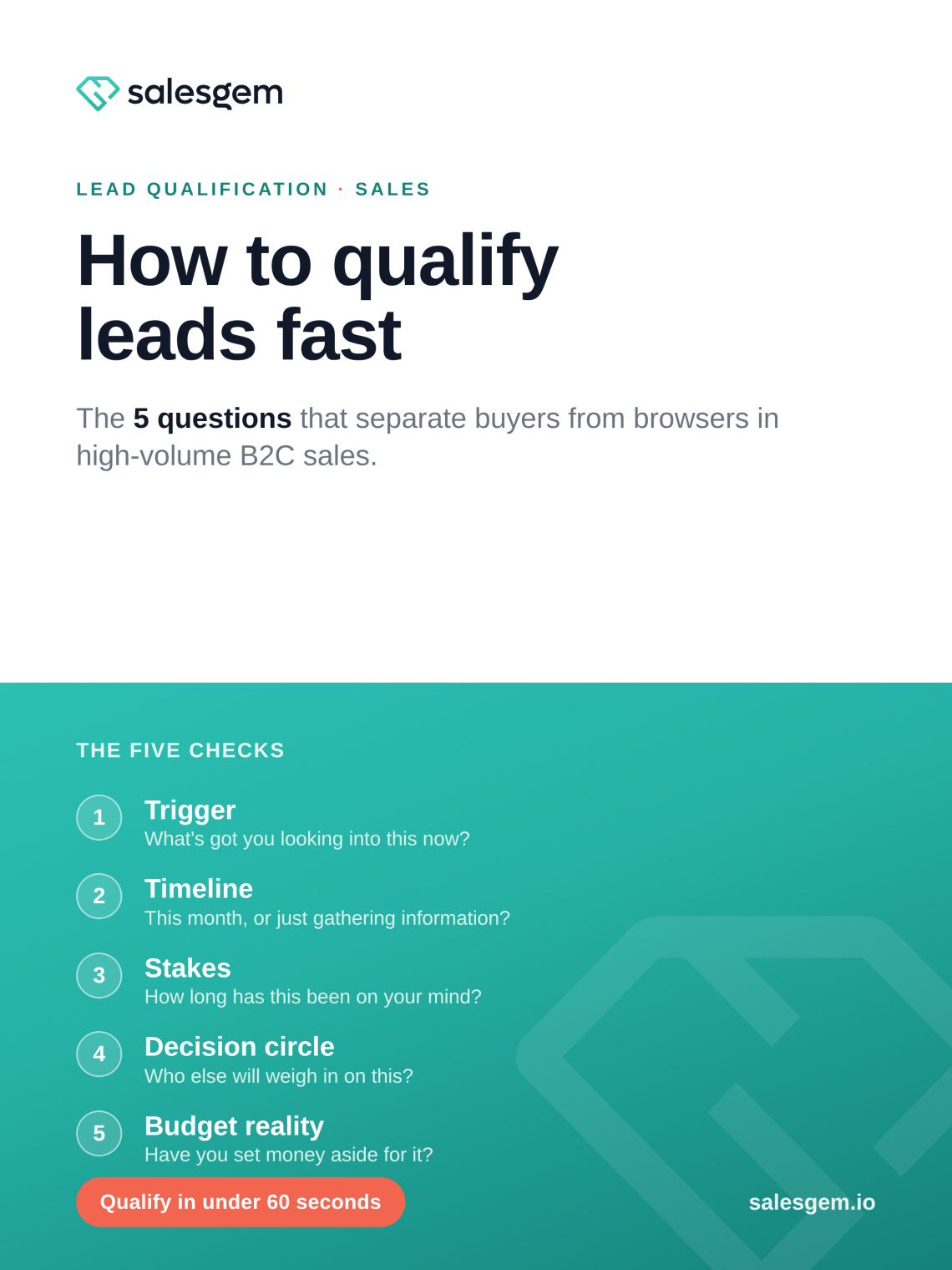
- “What’s got you looking into this now?” The trigger. A real reason that started recently beats vague curiosity every time.
- “Are you looking to get this sorted this month, or gathering information for later?” The timeline. This alone separates most buyers from most browsers.
- “How long has this been on your mind?” The stakes. Someone who has thought about a hair transplant for two years and finally called is a very different lead from someone who saw the ad this morning.
- “Who else will weigh in on this decision?” The decision circle. This stops you spending a week on a student who needs a parent to pay, or a partner who was never in the room.
- “Have you set money aside for this, or still working out the cost?” The budget reality. It is softer than asking for a number, and it surfaces the browser who has not priced anything yet.
Run questions one and two in the first sixty seconds. Questions three to five only come out if the lead stays warm.
Budget, timeline, and authority, translated for consumer sales
Anyone who has sold B2B knows the old BANT idea: budget, authority, need, timeline. It works, but it was built for a procurement committee, not for a parent on a WhatsApp call during their lunch break. In B2C you have to translate it.
Authority is rarely one named decision-maker. It is “who else is in the room,” usually a partner or a parent. Budget is rarely a signed-off figure. It is “have you started saving for this.” Need is rarely a documented business case. It is the trigger, the thing that happened this week. Timeline still matters most, because consumers buy on impulse and cool off just as fast.
So keep the four ideas, but ask them the way a person actually answers them. The five questions above are BANT in plain language, which is why they move so fast.
What changes by industry
The framework holds across verticals, but the disqualifiers shift. Here is what I watch for in the three industries I see most.
Aesthetic and healthcare clinics
High-ticket, self-pay procedures pull in heavy price-shopping and a lot of “just send me some information.” The trigger and budget questions do the heavy lifting here. One caution worth repeating: qualify for intent and readiness, then let the clinician judge medical suitability. Mixing the two is how clinics end up annoying good prospects.
Solar
Solar has a hard disqualifier that comes before any of the five questions. Does the person own a suitable property? A renter cannot install, so no amount of enthusiasm turns that lead into a sale. After ownership, the real intent signal is the size of the current electricity bill, not how keen they sound on the call.
Education and coaching
The person filling in the form is often not the person paying. A student enquires and a parent pays, or the other way round. So the decision-circle question moves up the list, and the timeline question gets tied to the intake or enrolment deadline, which is usually the trigger that makes a family act.
The 60-second rule, and why you never judge on one answer
Over the years I noticed a second problem, one that has nothing to do with the leads themselves. Two reps would speak to near-identical prospects and reach opposite conclusions. One marked the lead hot. The other wrote it off as low quality. Because nobody recorded the reasons, the sales manager could not tell whether the fault was the lead source, the questions asked, or the follow-up.
So I gave the team a shared process built on the same five checks: trigger, timeline, stakes, decision circle, and budget reality. We also added the essential conditions where they mattered, such as property ownership for solar or the paying adult for an education enquiry. The rule was simple. Inside the first sixty seconds of a call, decide buyer or browser. But that decision has to rest on recorded answers, not a gut feeling the rep cannot explain the next day.
That is where a reliable follow-up CRM for small teams earns its place. Do not rely on memory or a scroll of WhatsApp chats that no manager will ever read. The system should capture the qualification answers against each lead, note why it was marked hot or cold, and trigger the next action. With Salesgem, those answers stay on the lead record and the lead moves through Lead, MQL, then SQL as the rep confirms intent, so the next person to call continues the conversation instead of starting qualification from scratch. The manager can then see which leads reach a booked consultation or enrolment, not just which campaign produced the most enquiries.
Advice from ten years of doing this
If I could give a team one instruction, it would be this: qualify before you chase, and record why. Speed to the phone wins the first call, but qualification decides whether that call was worth making. The reps who burn out are the ones who treat every enquiry as equally promising. The managers who cannot improve are the ones who keep “hot” and “cold” only in their heads.
Build the five questions into the first minute of every call. Keep the industry disqualifier at the front where it belongs. Pair qualification with how fast you respond to a new lead and a follow-up cadence that does not pester people, and put a lead management process behind all of it so the answers outlive the conversation. Get that right and your consultation calendar fills with people who actually show up.
If you want those answers to live on the lead record instead of in a rep’s memory, you can sign up and try it on your next campaign. No credit card needed · 14-day free trial · Free support and migration.
Frequently asked questions
You qualify leads fast by asking two questions first, then letting the conversation breathe. Open with the trigger, “what’s got you looking into this now?”, and the timeline, “this month or later?”. Those feel like interest, not a checklist. Only if the lead stays warm do you ask about the stakes, who else decides, and budget. Three to five questions, spread through a natural chat, rarely feels like an interrogation.
The five questions are the trigger, the timeline, the stakes, the decision circle, and the budget reality. In plain words: what’s got you looking now, are you buying this month or later, how long has this been on your mind, who else weighs in, and have you set money aside. The first two do most of the sorting in under a minute.
You can reach a buyer-or-browser verdict in about sixty seconds, because the trigger and timeline questions answer most of it. Sixty seconds is enough to decide whether to invest more time, not to close. Treat it as a sorting gate. Full qualification, including budget and the decision circle, takes the rest of the call once the lead has passed that first minute.
B2C qualification compresses the B2B BANT model into questions a consumer answers naturally. Authority becomes “who else is in the room,” usually a partner or parent. Budget becomes “have you started saving.” Need becomes the trigger event from this week. Timeline matters most, because consumers buy on impulse and cool off fast. Same four ideas, plainer language, far quicker to run.
Recording answers in a CRM lets a manager see why a lead was marked hot or cold, which memory and scattered chats never show. It also means the next rep continues the conversation instead of re-qualifying from scratch. With Salesgem the answers stay on the lead record and move it through Lead, MQL, and SQL, so you can review which leads reach a booked consultation, not just which ad drove enquiries.