I have spent more than a decade fixing one specific leak: the gap between a lead submitting a form and a rep actually calling. Speed to lead is the name for that gap, and it decides more sales than price or product does. In the first hour after a Facebook or Instagram inquiry, buyer attention drops fast and competitor contact climbs. Most teams lose that hour to a broken handoff, not to lazy reps.
That handoff is exactly what a lead follow up CRM for small business is meant to fix. Before I get to the fix, though, it helps to watch the first hour play out the way the buyer actually experiences it.
The first hour, minute by minute
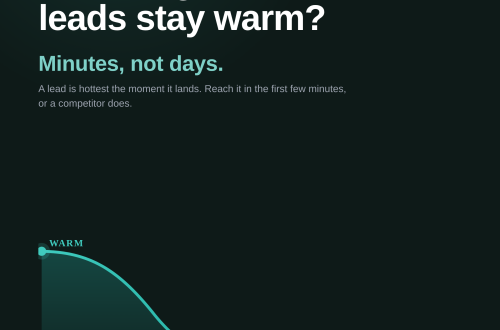
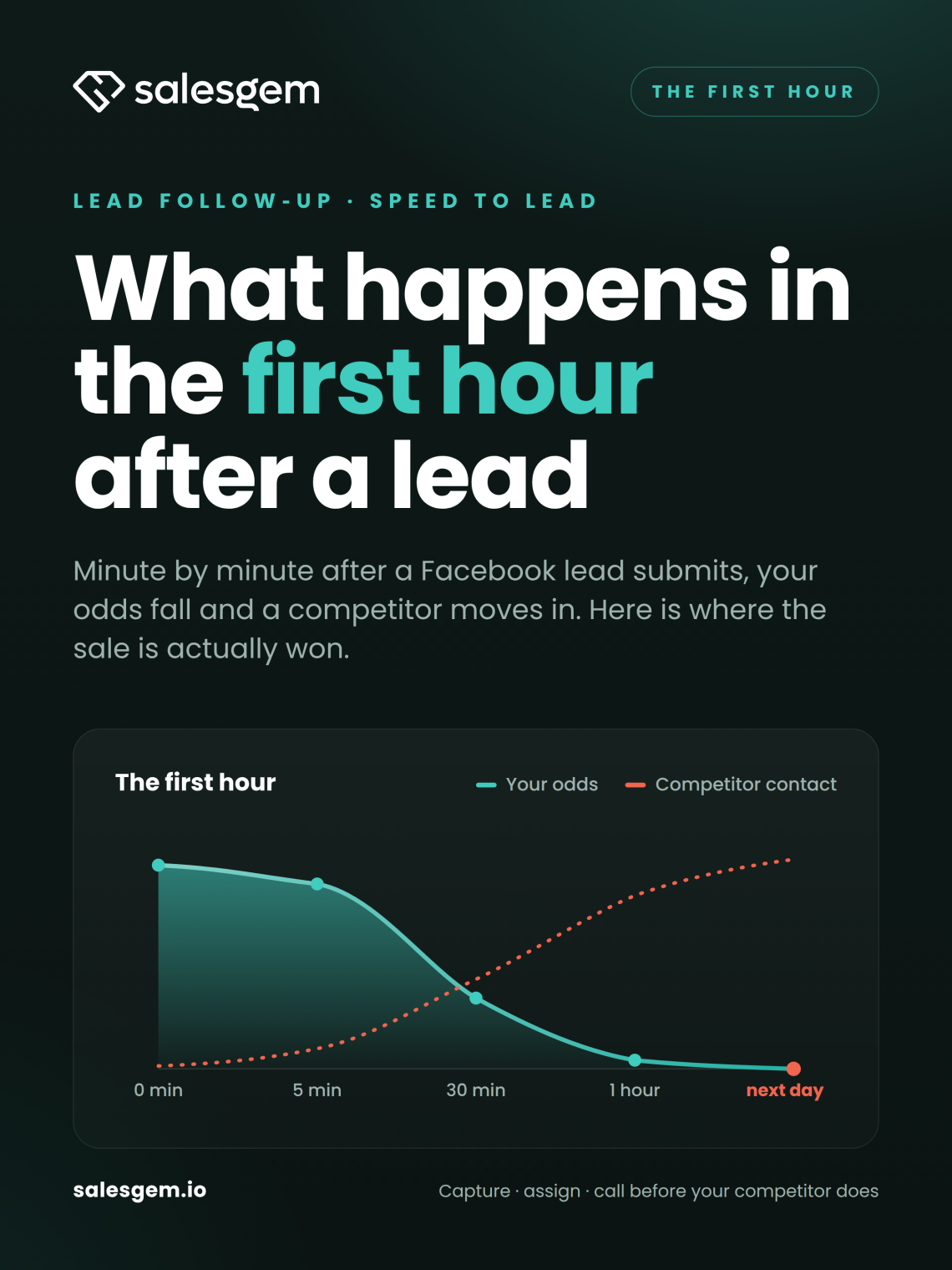
Picture someone researching lip filler at 9pm. When she fills out your Facebook lead form. She does not stop there. She fills out two more forms from clinics that appeared in the same feed. Right now, at minute zero, she is warm, curious, and comparing.
By minute five, she is still on her phone. If your text lands now, she reads it. She remembers submitting the form. The conversation feels natural.
By minute thirty, she has moved on to something else. Maybe she is watching a reel. Maybe another clinic already replied and offered her a slot. Your call now interrupts instead of continuing.
By hour one, one or two competitors have already reached her. The odds that you are the first voice she hears fall with every minute that passes.
By the next morning, the lead is cold. She may not even remember which clinic you are.
What the research actually says about the first hour
The research backs that story, as long as you cite it correctly, because most of the web mixes up two separate studies.
The first is the 2007 Lead Response Management study run by Dr. James Oldroyd at MIT Sloan with InsideSales.com. It examined three years of data across six companies, more than 15,000 leads, and over 100,000 call attempts. The finding: contacting a web lead within five minutes instead of thirty made a team roughly 100 times more likely to connect, and 21 times more likely to qualify that lead.
The second is a 2011 Harvard Business Review audit titled The Short Life of Online Sales Leads, by Oldroyd, McElheran, and Elkington. They submitted test leads to 2,241 companies. The average first response took 42 hours. Only 37 percent of firms answered within an hour. The ones that did respond quickly were far more likely to reach a real qualifying conversation.
One caution I always give teams: treat the exact multipliers as directional, not as physical law. The size of the effect shifts by industry, channel, and lead source. The direction never changes. Faster contact wins more deals. If you want the deeper breakdown, I covered it in our piece on Facebook lead response time.
Speed to lead is a system problem, not a motivation problem
Early in my career, I ran inbound leads for an aesthetic clinic. On paper, marketing looked excellent. We generated hundreds of Facebook inquiries every month. The trouble started after the form was submitted.
The lead landed in Meta. Then someone exported it. Then someone shared it with the front desk. Eventually a salesperson called. Sometimes that took thirty minutes. Sometimes two hours. On weekends, some leads waited until Monday.
The team kept telling me the same thing: Facebook leads are not serious. I did not agree. So I started tracking the time between each inquiry and the first contact. The pattern was hard to miss. Our best leads were often the ones that had waited the longest.
We replaced the manual process with a CRM. It captured every lead the moment it arrived, assigned it to a salesperson, triggered an alert, and recorded the first contact time. For the first time, the manager could see which leads sat untouched and which reps were calling late.
That lesson stayed with me. Speed to lead stops being a motivation problem once you accept that the system itself creates the delay. A CRM fixes the handoff before you ever ask the salesperson to fix the follow-up.
The same problem, seen from the agency side
Years later, I worked with an agency running Facebook campaigns for several businesses. The agency generated plenty of inquiries. Still, clients kept complaining that the leads were poor quality.
I asked one simple question. How quickly did your team contact them? Nobody had a reliable answer.
The agency sent leads to clients through spreadsheets, email, and shared accounts, then lost all visibility. A lead could sit untouched for an hour while the client was busy with something else. By the time someone called, the prospect had already talked to competitors.
We moved the whole process into a CRM. The system captured every lead automatically, assigned it to a specific rep, and time-stamped it from arrival to first contact. Managers could finally see missed leads, response times, follow-up activity, and where prospects dropped out.
That changed the conversation completely. Instead of arguing about whether the leads were bad, we could see whether the sales process had given those leads a fair chance.
After years of managing sales teams, I keep landing on the same conclusion. A CRM is not only a place to store leads. It creates accountability between the ad click and the actual sales conversation.
Why the first hour breaks down in different industries
The first hour breaks down in a different way in each industry, even though the root cause is the same.
In healthcare and aesthetic clinics, the person who should answer the lead is usually the front desk. That same person is checking in patients, answering the phone, and running the waiting room. A Facebook message does not stand a chance against a patient standing at the counter.
In solar, homeowners now collect three to five quotes per project. The installer who replies first often wins, regardless of price. Yet the rep best able to sell is out on a roof doing a site assessment when the lead comes in.
In coaching and education, inquiries arrive at night and on weekends, when parents and students actually have time to research. Counselors work school hours. During admission season, a small team can receive hundreds of enquiries in a week with no realistic way to answer even a fraction within the hour.
Different industries, same story. The lead arrives during the one hour that matters, and the right person is not there to catch it.
How to win the speed-to-lead race
Fixing this comes down to fixing the system before you coach the people. Here is the advice I give every team I work with.
- Capture the lead the instant it is submitted. Do not wait for an export.
- Assign it automatically to a named rep, so no lead becomes everyone’s job and therefore no one’s.
- Push an alert to that rep’s phone, because the lead does not care that it is 9pm on a Saturday.
- Time-stamp the first contact, so the manager can see response times instead of guessing.
- Qualify fast, so reps spend the first hour on buyers rather than on tire kickers.
Pair that with a consistent follow-up cadence and the first hour stops being the place your pipeline quietly leaks.
This is the gap Salesgem was built to close. It captures Facebook, Instagram, and WhatsApp leads the moment they arrive, assigns each one to the right rep, pushes it to their phone, and records how long first contact took. The manager gets visibility. The rep gets the lead while it is still warm.
If your ad spend is healthy but your follow-up is not, that is where to start. You can Sign Up and try it on your own leads. No credit card needed, 14-day free trial, free support and migration.
Speed to lead is less about working harder in that first hour, and more about building a system that never loses the hour in the first place.
Frequently asked questions
Speed to lead is how quickly a sales team makes first contact after someone submits an inquiry or lead form. It is measured in minutes, not days. The faster the first touch, the higher the chance of reaching and qualifying the lead. Research from MIT and InsideSales found the sharpest drop happens once you pass the five minute mark.
You should follow up on a Facebook lead within five minutes whenever you can. Buyer attention peaks in the first few minutes after a form submit, then falls quickly. Most people submit several forms at once, so the first business to reply usually wins the conversation. Anything measured in hours puts you at a real disadvantage.
Facebook leads often feel like poor quality because of slow follow-up, not bad targeting. When a lead sits for an hour or more, the prospect has already contacted competitors or lost interest. The lead was warm at submission. By the time someone calls, it has gone cold. Tracking first contact time usually reveals the real problem.
A good lead response time is under five minutes for a fresh inquiry. A Harvard Business Review audit found the average company took 42 hours to respond, and only 37 percent replied within an hour. If you consistently make first contact inside the first few minutes, you are already ahead of most of your market.
A CRM improves lead follow up by removing the manual handoff that creates delay. It captures each lead instantly, assigns it to a specific rep, alerts that rep, and records the first contact time. Managers can then see untouched leads and late responses. The system catches the lead while it is warm instead of relying on memory.