You manage WhatsApp leads at scale by giving every lead one clear owner, keeping the full conversation history in one place, and automating only the predictable messages. Assignment, reminders, and routine confirmations belong to software. Pricing questions, objections, and product choices stay with the salesperson. A CRM for WhatsApp leads is what makes that split workable once volume climbs.
Where I learned to manage WhatsApp leads
I have spent more than ten years running and advising sales teams, and for the last few of those years almost every one of them has ended up selling on WhatsApp. Clinics, coaching institutes, solar installers, home service companies. Different products, same channel, and eventually the same complaint from the owner: “we are getting plenty of leads, but the team is not closing them like they used to.”
I still talk to sales heads across these industries most weeks. The pattern repeats so often that I now expect it. Teams do not lose the personal touch because reps stop caring. They lose it because the process that worked at thirty leads a month quietly breaks at three hundred, and nobody notices until the numbers slip.
Here is what actually happened on two of those teams, and what I changed.
The first problem was ownership, not volume
When I was managing sales for a business whose WhatsApp leads were growing month on month, I assumed volume would be the first thing to break. It was not.
The first thing that broke was ownership.
In the early days I let reps pick up whichever WhatsApp chat was free. With a manageable number of leads, that worked fine. Once volume increased, it turned messy. Two reps would reply to the same customer within minutes of each other. Meanwhile another lead sat untouched for an hour. Worst of all, a customer would explain their requirement in detail to one rep, then receive a completely fresh opening message from someone else, as if the first conversation never happened.
That customer does not think “this business is busy.” They think “these people are not listening.”
I changed three things.
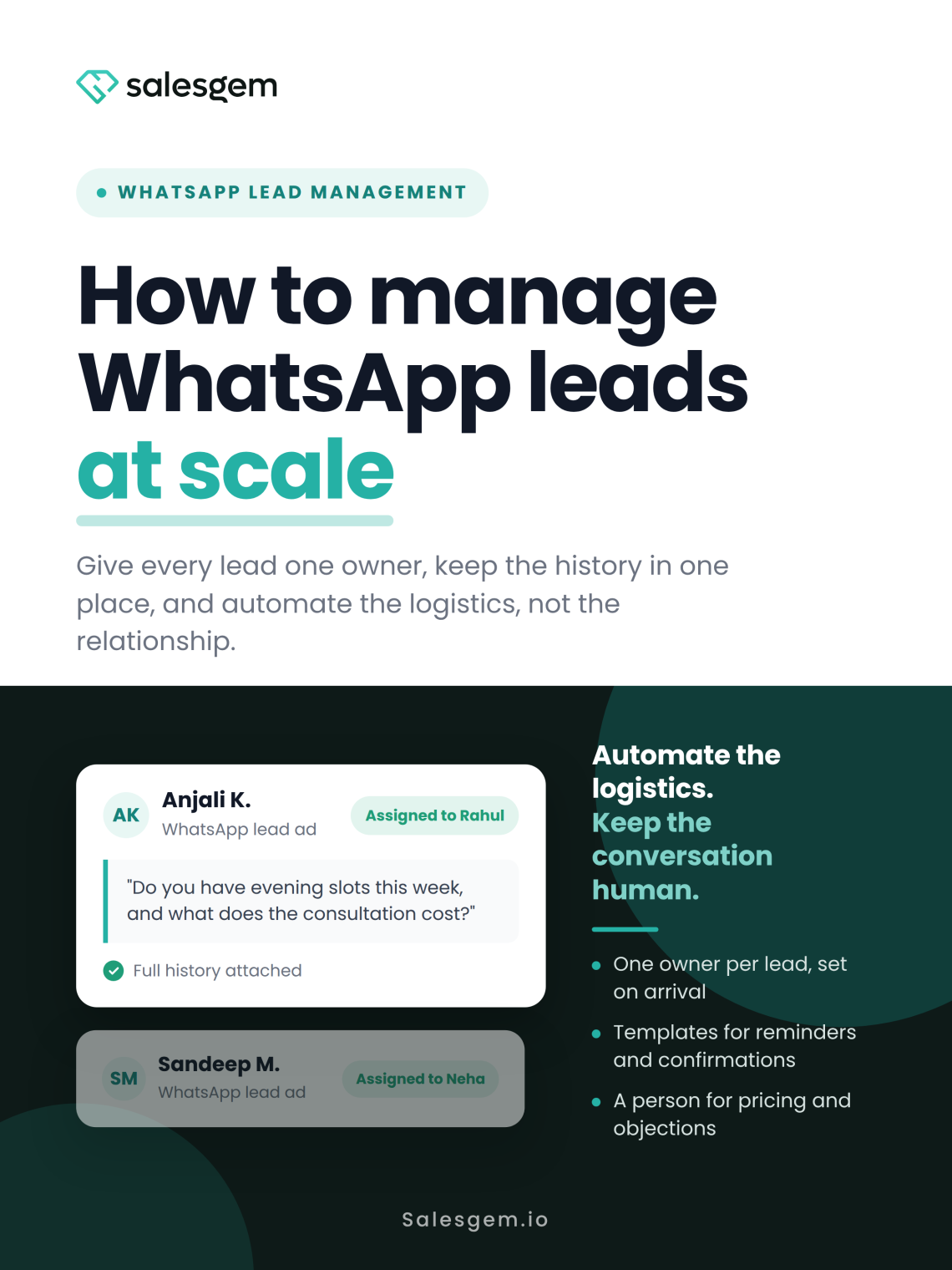
I assigned every new WhatsApp lead to a specific rep the moment it arrived. The CRM did the assignment, not the team. Each rep knew exactly which conversations belonged to them. Nobody competed over the easy leads, and nobody assumed someone else would pick up the difficult ones.
I made the conversation history part of the lead record. Before replying, a rep could see the original inquiry, the earlier messages, the notes, and where the conversation had reached. Personalization got much easier, because the rep was no longer starting from zero every time.
I started measuring time to first reply by rep, instead of counting how many conversations each person handled. That single change moved behaviour more than any coaching session did. Reps still moved quickly, but they now had enough context to make the first response relevant rather than identical.
The lesson stayed with me. Personalization does not scale by asking reps to be more personal. It scales when each rep has clear ownership and enough context to hold a relevant conversation quickly.
Then fast replies started sounding identical
The second problem arrived on a different team, and it looked like success at first.
Response times were dropping. The dashboard looked healthy. But the conversations were getting worse.
The reason was simple once I read the chats. Reps were under pressure to reply fast, so they copied the same message into multiple chats. A customer asking about recovery time and a customer asking about instalments were receiving the same paragraph. Efficient on paper, and useless in practice.
So I changed how the team used the CRM rather than how hard they worked.
Templates handled the predictable information: appointment confirmations, reminders, location details, quote notifications. A salesperson does not need to rewrite an address at eleven at night.
Anything that needed judgment went back to a human. Pricing questions, objections, product choices, unusual requests. The rep took over personally, and because the CRM held the form details, the earlier WhatsApp conversation, the notes, and the follow up history in one screen, they could answer without asking the customer to repeat anything.
I also added reminders for conversations approaching the 24 hour WhatsApp limit, which I will come back to in a moment.
That is when volume stopped hurting quality. We were not removing human conversations. We were removing the repetitive work sitting around them.
My rule became short enough to say in a sales meeting: automate the logistics, not the relationship.
What to automate and what to keep human
This is the split I now hand to every team I work with.
Automate:
- Lead assignment and routing to the owning rep
- Appointment confirmations, reminders, and reschedules
- Location, directions, timings, and document checklists
- Quote and invoice notifications
- Follow up reminders for the rep, including window expiry alerts
- Logging of conversation history and notes
Keep human:
- Pricing conversations and discount requests
- Objections of any kind
- Choosing between products, packages, or treatment options
- Anything where the customer sounds uncertain or emotional
- Anything a template has already failed to answer once
The test I use is blunt. If the answer is the same for every customer who asks it, a template can send it. If the answer depends on what this particular person said, a salesperson writes it.
The 24 hour window is a sales deadline, not a technicality
Most teams treat WhatsApp timing as an IT detail. It is a revenue detail.
Meta’s own documentation is clear on how this works: when a WhatsApp user messages you, a 24 hour customer service window opens or refreshes, and while it is open you can send any type of message. Once it closes, you can only send an approved template, and only to users who opted in to hear from you.
Read that again as a sales manager. A rep who falls half a day behind loses more than time. Once that window shuts, the option to reply in their own words is gone, and all that remains is a template. That is exactly the generic message you were trying to avoid.
This is why I want reminders firing while the conversation is still open, not a report telling me on Friday that four warm leads went quiet on Tuesday. The CRM should be nudging the rep with hours to spare, so a real person answers a real question in time.
If your team is still running the free WhatsApp Business app, this gets harder for a structural reason rather than a discipline one. That app was built for very small teams. There is no shared inbox and no proper agent assignment, and the device limit means people end up sharing one login or one phone. Duplicate replies and missed threads are not a coaching problem at that point. They are a tooling problem. The difference between the WhatsApp Business app and the API is worth understanding before you blame the team.
How this plays out in different industries
The principles hold everywhere, but the pressure point changes by industry. These are the four sectors I get called into most often when a team starts to manage WhatsApp leads in serious numbers.
Clinics and aesthetic practices
This is where the gap shows fastest. Patients message three clinics at once and compare replies in real time, so a slow or robotic response loses the booking to whoever sounded human first. The bigger issue is trust. Someone asking about downtime, pain, or a procedure they are embarrassed about needs a specific and reassuring answer, not a cheerful template. And the person answering WhatsApp is usually also handling the front desk and the phone.
Education and coaching
Volume here is spiky rather than steady. One webinar or one admission deadline can triple inbound messages overnight. Parents want guidance on fit, which cohort and which course, and that is a conversation, not a broadcast. The trap is that the window resets on the customer’s message, so a counsellor stuck on a two hour call can lose free form access to several people at once.
Solar and other considered purchases
The sale runs over weeks and includes site visits, financing, and subsidy questions that vary by location. Trust carries the whole deal, so a generic reply costs more here than anywhere else. The practical complication is that WhatsApp usually doubles as the project coordination channel, so new leads get buried under messages from existing customers about installation dates.
Home services
Urgency is the whole game. When someone messages because their air conditioner died this morning, the instinct under load is an auto reply saying the team will get back to them. That is the exact moment a competitor who answers personally wins the job. Automate the dispatch details, never the first reply.
Scaling WhatsApp is not the same as sending more messages
I want to be direct about this, because plenty of tools sell the opposite.
When lead volume grows, the tempting move is to push more outbound templates to more people. It looks like scale. It is actually the fastest way to train customers to ignore you, get your number reported, and damage the one channel where people still read what you send.
WhatsApp works for sales precisely because it feels personal. Every broadcast you send spends a little of that. Spend enough of it and you are left with an expensive SMS gateway.
Scaling properly means the opposite: fewer generic messages, sent to fewer people, with more of the rep’s time freed for conversations that actually decide a sale. That is also why I care about which CRM sits behind the channel. If you are comparing options, look at how each one handles assignment, history, and follow up rather than how many messages it can blast. I have written separately about choosing a WhatsApp CRM for a sales team.
What I would tell a sales manager starting this week
If you are watching your WhatsApp volume grow and you can feel the quality slipping, do these in order.
- Fix ownership first. Every lead gets one named owner at the moment it arrives. Do this before you touch templates or scripts.
- Put the history where the rep replies. If your rep has to scroll a phone or ask a colleague what happened, personalization is already lost.
- Change what you measure. Time to first reply by rep, plus a weekly read of actual conversations. Volume handled tells you nothing about quality.
- Write templates only for logistics. Confirmations, reminders, directions, documents. If a template is answering an objection, delete it.
- Set reminders against the 24 hour window. Catch the conversation while a human can still reply in their own words.
- Read ten chats a week yourself. Not reports. Chats. You will find the copied paragraph within minutes, and your team will know you are reading.
None of this requires a bigger team. It requires the repetitive work to move off the salesperson so the parts that need a human still get one.
Salesgem captures Facebook, Instagram, and WhatsApp leads, assigns each one to a rep with the full history attached, and keeps the follow up on schedule. If that is the gap you are trying to close, Sign Up and run it against a week of real leads.
No credit card needed · 14 day free trial · Free support and migration
Frequently asked questions
Managing WhatsApp leads at scale without sounding robotic comes down to a split. Automate the predictable messages, such as appointment confirmations, reminders, and quote notifications. Keep pricing questions, objections, and product choices with a salesperson, and give that person the customer’s full history before they reply. The customer feels the difference immediately, because the answer matches what they actually asked.
The 24 hour window is the period after a customer messages you during which your business can send any type of message. Meta refreshes that timer each time the customer messages again. Once it closes, you can only send an approved template to customers who opted in. For sales teams, that means a late reply costs you the ability to answer in your own words.
Separate personal numbers create the exact problems you are trying to solve. History stays on one phone, managers cannot see the conversation, and leads leave with the rep. One business number with proper assignment inside a CRM gives each rep clear ownership of specific conversations while keeping the record with the company.
Use templates when the answer is identical for everyone who asks, such as directions, timings, confirmations, and document checklists. Write personally when the answer depends on what the customer said, which covers pricing, objections, comparisons between options, and anything where the customer sounds unsure. If a template has already failed to answer a question once, a person takes over.
Assign each lead to one owner automatically as it arrives, rather than letting reps pick up whatever chat is free. Assignment removes the competition over easy leads and the assumption that someone else will handle the difficult ones. A shared record of who owns what, visible to the whole team, prevents duplicate replies without anyone needing to ask.