The best CRM for agencies delivering leads to clients does four things. It pushes every Meta lead into the client’s account the moment it arrives. Each client’s data stays separate. It records what the client’s team actually did with the lead. And it gives the client a view of their own pipeline. Most tools do one of those well and ignore the rest.
I have worked as a sales consultant for a little over ten years. I have sat inside clinics, coaching institutes, solar companies and dealerships, and I have sat on the agency side too. The conversation I have had most often in that decade is the one where a client says the leads were rubbish, and the agency owner has nothing to show that says otherwise. So this is not a feature roundup written from vendor pages. It is the shortlist I actually give agency owners when they ring me.
The month I stopped blaming lead quality
Years ago I was running lead generation for a mixed roster of clients. Around eight accounts, all on Facebook and Instagram. The ads were fine. So were the forms. Cost per lead was fine too.
Then one client called and said the leads were worthless, and I had no answer.
I had no idea when their receptionist had called anyone. Worse, I could not tell whether she had called at all. I had a spreadsheet of leads I had handed over three weeks earlier and nothing else. I lost that account, and I deserved to, because I had built a process that ended the second the lead left my hands.
What I actually needed from a CRM
That week I went looking for a CRM. I had a specific and fairly boring list of wants. It had to be cheap enough to put in front of a client without a negotiation. It had to be simple enough that a receptionist would open it. Assignment and reminders had to happen on their own. And it had to hold the questions my clients actually asked their customers.
That last one turned out to be the sticking point. A hair transplant clinic needs to know the treatment of interest and the preferred consultation date. Coaching institutes need the course and the batch. A solar installer needs the roof type and the monthly bill. None of that fits in a standard name and phone field, and when it does not fit, it ends up in a WhatsApp thread nobody reads.
That is what sent me looking for CRM custom fields, and it is how I first came across Salesgem. You create the field in settings, choose the type, and it appears on the lead record, on the new lead form and in the lead list. Small thing. It solved the problem I actually had, which is more than I can say for the two heavier tools I trialled that month.
Why no best CRM for agencies list from me includes agency operations software
Search for agency software and you get project trackers, timesheets and retainer billing. Good tools. Wrong tools for this job.
Agency operations software manages your side of the relationship. Tasks, hours, invoices, deliverables. It tells you how your team is doing. It tells you nothing about whether your client’s receptionist rang the lead you sent at 2pm on Tuesday.
Churn does not usually start on your side. It starts on theirs, in the gap between the lead arriving and someone picking up the phone. A tool that cannot see into that gap cannot help you defend a retainer, no matter how nicely it tracks your timesheets. So none of them are on this list.
How I score the best CRM for agencies
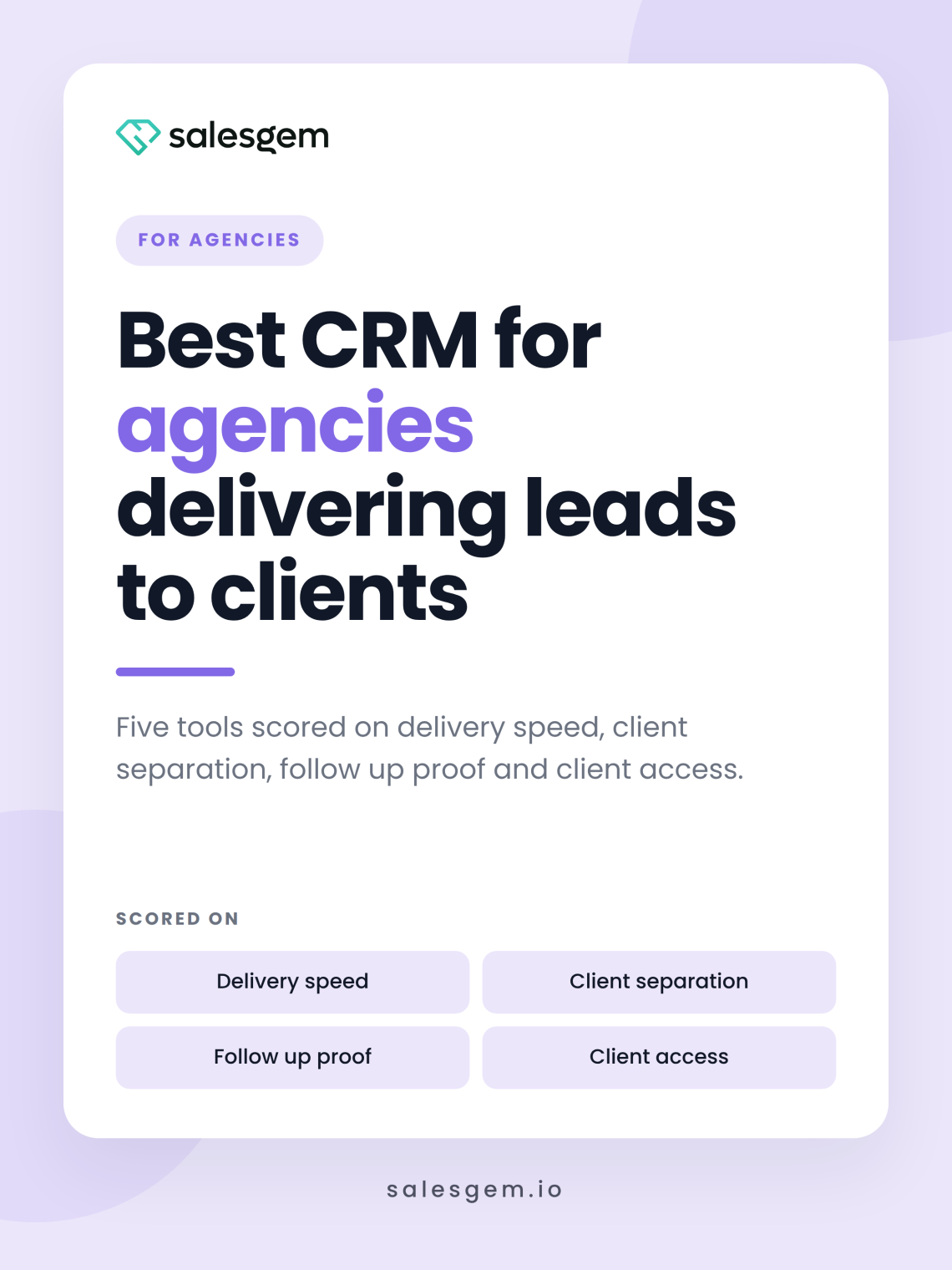
So I score every tool on the same four things, in this order.
- Delivery speed. Does the lead land in the client’s account on its own, or does somebody export a file?
- Client separation. Does each client get their own workspace with their own leads, or is everyone in one pot with tags?
- Follow up proof. Can you show a timestamp of when the lead arrived and when the client’s team touched it?
- Client access. Can the client see their own pipeline without you handing over your ad account?
Cost and setup time sit underneath all four. An agency with six clients on a modest retainer will not buy a tool that costs more than one of those retainers.
The best CRM for agencies: five tools worth your time
Salesgem Agency Mode
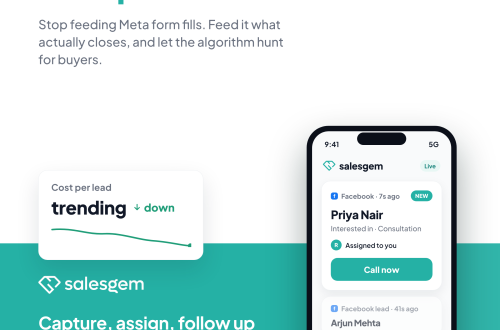
If you judge the best CRM for agencies purely on the four criteria above, this is the one built for the exact job. Each client gets their own workspace with their own lead pipeline, WhatsApp inbox and reports, and you switch between them from one agency dashboard. Facebook and Instagram lead form submissions land in the right client’s pipeline on their own. You can assign any client account to one of your account managers, who then sees that client’s pipeline and activity and can chase stalled deals from inside it.
Campaign level reporting ties leads back to the campaign that produced them, which is the report you want in the room during a renewal conversation.
Where it is weak: the published agency plan covers 5 agency users and 10 client accounts, so a shop running thirty clients needs a conversation rather than a signup. Salesgem does not advertise white label branding, so assume your clients see Salesgem. And it is built around Meta and WhatsApp. If your clients live on LinkedIn or TikTok, this is not your tool.
Worth reading alongside this: the lead delivery bottleneck every agency runs into.
GoHighLevel
The heavyweight, and the right pick for any agency running a resale model. At $297 a month on the Unlimited plan you get unlimited client accounts, API access and white label desktop branding, and at $497 you get SaaS mode, which lets you resell the whole thing under your own name and bill clients through it. The $97 Starter plan caps you at three client accounts, which you outgrow on your fourth client.
Where it is weak: usage costs sit on top of the sticker price, since SMS and email are billed through separate providers. It is also a lot of tool. Funnels, calendars, memberships, automations. If you want a lead pipeline and nothing else, you are buying and maintaining machinery you will never switch on, and your client’s receptionist has to learn it.
Choose it when white label resale is part of your business model. That is the case it wins outright.
Privyr
Genuinely fast, genuinely simple, and the free plan sends instant lead alerts to a phone. For a solo agent whose CRM is their handset, it is hard to beat, and it connects to Facebook Lead Ads, TikTok, Google Ads and web forms directly.
Where it is weak for this job: it is a personal CRM, not an agency layer. There is no client workspace model, pipeline reporting is thin, and paid plans carry per lead distribution fees that stack up once volume climbs. Team controls exist but stay basic.
Choose it when your client is one person with a phone. Not when they are a five person sales floor you need to audit.
Zoho Bigin
A tidy small business CRM at roughly $7 to $18 per user per month, with native WhatsApp, a clean pipeline view and a low learning curve. If a client already runs Zoho, putting them on Bigin is a short conversation.
Where it is weak: there is no agency layer at all. Bigin is built for one company running its own pipeline. Managing eight clients means eight separate Bigin organisations, eight logins and eight bills, with no combined view across them. You are doing the multi client work yourself, in browser tabs.
Choose it when you have one or two important clients and you want them on something solid and cheap.
LeadSync and LeadsBridge
Worth naming because agencies reach for them constantly, and because they are honest about what they are. These are delivery pipes. LeadSync runs $19 a month flat, with a $99 agency tier covering unlimited leads across client accounts. LeadsBridge has a free tier capped at 50 leads and two mapped fields, with paid plans from around $22.
Where they are weak: a pipe is not a pipeline. They move the lead from Meta into whatever your client already uses. They do not tell you whether anyone rang it. If your client’s CRM is good, a pipe is all you need. If your client’s CRM is a spreadsheet, a pipe just moves the problem faster.
Meta’s own forwarding is the free version of this, and it is real time, but it supports roughly ten destinations, has no field mapping and sends no notifications.
The industries where the best CRM for agencies earns its keep
Because the pain is not evenly spread, the best CRM for agencies in one vertical can be overkill in another. Some verticals punish a slow handoff far more than others, and those are the accounts where a proper setup pays for itself in one saved retainer.
Clinics and aesthetics. A consultation enquiry that goes unanswered for four hours becomes a no show or a booking at the clinic down the road. Response speed shows up directly in the appointment book, which makes it very easy for the client to see whose fault it was.
Education and coaching. Enquiries spike the week a batch opens and go dead the week it closes. A lead contacted on day five of a ten day admission window is worth a fraction of one contacted on day one.
Solar and home improvement. These buyers request quotes from three or four installers in one sitting. Whoever calls first sets the comparison and frames everyone else’s quote as expensive.
Auto dealerships. Enquiries route to a specific showroom or a specific model specialist. Route it wrong and it dies quietly in someone’s queue.
Insurance and finance. Renewal dates and policy types have to travel with the lead. Without those fields, the rep opens a record with a name and a number and nothing to say.
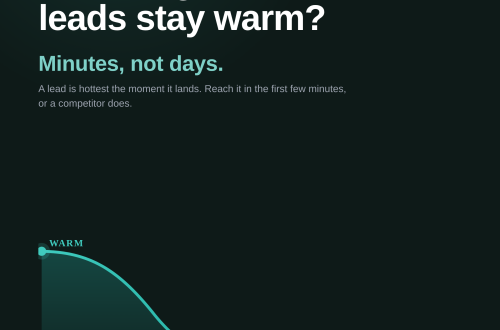
The common thread is that the buyer is actively shopping right now. That is where delivering Facebook leads to clients in real time changes the outcome rather than just tidying the workflow.
What I tell agency owners about picking the best CRM for agencies
Three things, after ten years of getting this wrong before I got it right. None of them are really about software.
Stop delivering leads. Start delivering a process. The moment you hand over a spreadsheet, you have handed over your evidence too. Put the lead into something you can both see.
Choose the boring tool your client will actually open. I have watched two clients abandon a capable CRM because the daily view had eleven tabs. Adoption beats capability every time, and a receptionist is your real end user.
Decide the fields before the first lead arrives. Ask each client the three questions their sales team asks every enquiry, then build those as fields on day one. It takes twenty minutes and it changes every call that follows.
So if your roster runs on Meta ads and WhatsApp, and your problem is proving follow up rather than reselling software, then the best CRM for agencies in your situation is a narrow one. the CRM for ad agencies approach Salesgem takes is the closest fit on this list. You can sign up and set up a client account without a card. No credit card needed · 14 day free trial · Free support and migration.
Frequently asked questions
The best CRM for agencies delivering leads to clients is one that gives each client a separate workspace, delivers Meta leads into it automatically, and timestamps follow up activity you can show during renewals. Salesgem, GoHighLevel, Privyr, Zoho Bigin and LeadSync each fit a different agency shape. Score them on delivery speed, client separation, follow up proof and client access before you compare feature lists.
Yes. A client workspace inside a CRM is separate from your Meta Ads account, so the client logs in to see their own leads and pipeline while campaign structure and spend stay in Ads Manager under your control. Confirm exactly what each client role can view before you invite anyone, since the split varies between tools.
A Facebook lead should reach the client’s sales team instantly, through a direct connection rather than a file export. Meta’s native forwarding and purpose built CRMs both deliver in real time. Manual CSV downloads typically introduce hours of delay, and that delay is where most agency blame for poor lead quality actually originates.
No, and running one CRM per client is the mistake that makes agency reporting painful. Choose software with a multiple client model, where every client has an isolated workspace but you manage all of them from one agency dashboard. Separate accounts mean separate logins, separate bills and no combined view across your roster.
No. Project management and agency operations software tracks your own team’s tasks, hours and deliverables. It has no view of the client’s sales pipeline, so it cannot show when a lead arrived or whether anyone followed up. Those are the two facts that decide retainer conversations, so use lead management software for this job.