The Facebook lead delivery bottleneck every agency runs into
After more than ten years running Meta ads for clients, I’ve learned something uncomfortable. How the lead delivery bottleneck every agency runs into. Most lead problems agencies get blamed for are really Facebook lead delivery problems. The leads exist. They just get stuck between the ad account and the salesperson who should call them. So they go cold while everyone waits. That gap is where retainers quietly die.
The gap nobody sees on the dashboard
I’ve worked with clients in real estate, insurance, clinics, and coaching. The industries differ, but the story rarely does. The agency builds a campaign that performs. Cost per lead looks fine. The volume is there. Then, a few weeks in, the client sends the message every agency owner dreads: “the leads aren’t converting.”
Here is what usually happens instead. A Facebook or Instagram lead form gets submitted, and the lead lands in Meta Lead Center. After that, someone on the client’s side has to log in, download a CSV, open a Google Sheet, and pass the leads out. Sometimes that takes an hour. Often it takes half a day. Sometimes nobody touches it until the next morning.
By then, the person who filled out the form has moved on. They filled out three other forms too. Whoever called first already had the conversation. The ads did their job. The delivery did not.
Why Facebook lead delivery decides who calls first
Speed matters here for a reason. The lead response studies from MIT and Harvard Business Review have shown for years how fast your odds of reaching a lead fall once the first minutes pass. None of that shows up on the ad dashboard, though. The agency sees impressions, clicks, and cost per lead. Meanwhile, the client sees a spreadsheet of people nobody called.
That is the whole problem in one line. Good Facebook lead delivery is not about sending more leads. It is about getting each lead to a person while it is still worth calling.
When the campaign works and the client still isn’t happy
A few years ago, I ran Meta ads for a real estate client. We generated 40 to 50 leads a day, and the campaign performed well. Still, the client kept telling me, “we’re not getting enough leads.”
That did not match what I saw, so I dug into their process. The leads were sitting inside Meta Lead Center. Someone on their team had to download the CSV by hand, update a Google Sheet, and pass leads to the salespeople. Sometimes that took two or three hours. Sometimes nobody touched it until the next day. By then the hottest leads had gone cold.
Here was the frustrating part. From my side, the ads worked. The client never saw that. They only saw the end result: leads nobody contacted, and conversions that stayed low.
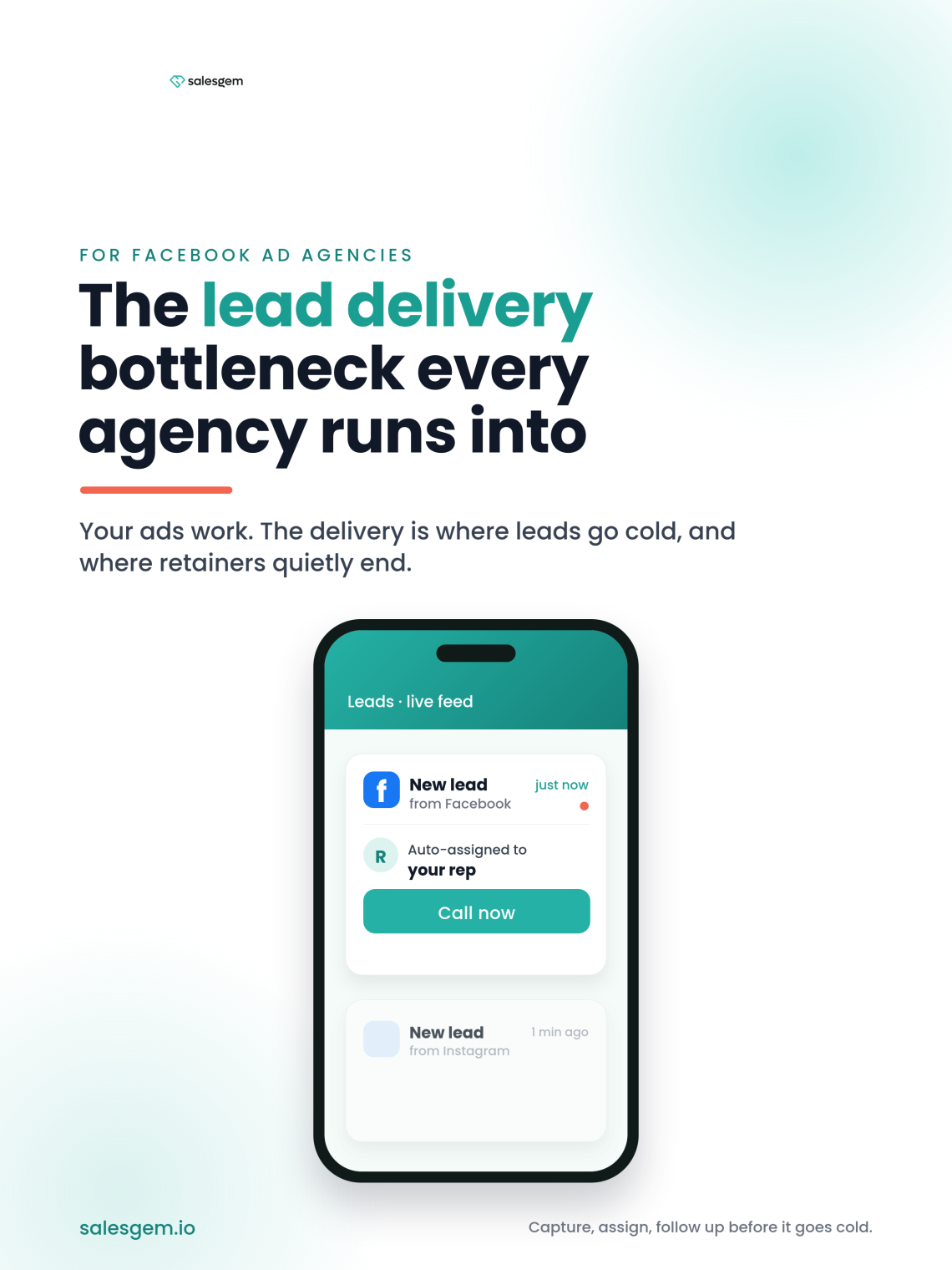
Eventually, we connected the ads straight to a CRM. Now the system captured each new lead the moment it arrived. It assigned that lead to a salesperson and notified the team right away. The campaign did not suddenly improve. Instead, the delivery got faster, and the team could finally work leads while they were still warm.
“Facebook is sending bad leads” usually means something else
Another time, I managed ads for an insurance company taking in around 60 leads a day from Meta. At first, everyone blamed lead quality. The sales manager kept repeating, “Facebook is sending bad leads.”
So I looked closer, and the quality was fine. The real issue was assignment. New leads went into a WhatsApp group with five salespeople in it. Nobody knew who owned which lead. One rep assumed another had already called. One lead got forgotten completely. Others reached a salesperson hours late.
We were delivering the leads. The client simply had no reliable way to receive, assign, and follow up. Once they moved the process into a CRM, every lead went to one salesperson automatically. Each came with a notification and a follow-up reminder attached.
The biggest change was not more leads. It was that every lead finally had an owner.
Why slow Facebook lead delivery is an agency problem
You might decide the follow up is the client’s job, so the mess is theirs. On paper, that is true. In practice, though, the agency pays for it.
When leads sit uncalled, the client does not question their own process. They blame the leads, which means they blame you. Then you defend the campaign at renewal with no data on whether anyone called. You can show cost per lead. You cannot show follow-up, because it lives in a spreadsheet you never see.
There is a second trap too. Clients want their leads in real time. Yet you cannot just hand over ad account access, because that exposes your campaigns, your spend, and your creative. So you fall back on manual exports and forwarded files. That is exactly what caused the delay in the first place.
That is the real bottleneck. It is not the ads. It is the handoff.
How different industries feel the same bottleneck
The delay costs more in some verticals than others. It helps to know which clients will feel it hardest.
In aesthetic and healthcare clinics, the person meant to work the lead is often front desk staff, mid-consultation with a patient in the chair. High value treatments get shopped across several clinics at once. So the clinic that calls first books the consultation. A lead left in an inbox is a booking that went down the road.
For education and coaching clients, leads spike in the evenings and on weekends. That is exactly when counselors are offline. Someone comparing courses enrolls with whoever follows up while they are still deciding.
Solar is the most literal race of all. Aggregators often sell the same homeowner to several installers. The appointment goes to the fastest caller, and field teams are not sitting at a desk watching a CSV.
Real estate, the vertical from my first story, sits in the same trap. Leads flow constantly, agents work in the field, and first contact wins the showing. Different clients, one bottleneck.
What actually fixes the handoff
Every version of this problem came down to the same three gaps. Leads arrive late. Nobody owns them. The agency has no visibility. A CRM wired straight to the lead source closes all three.
Here is what changes when delivery runs through a CRM instead of a CSV. The system captures the lead the moment the form is submitted, with no manual download. It assigns that lead to one salesperson, so ownership is never in doubt. That person gets notified right away, plus follow-up reminders, so leads do not die in a group chat. And because everything is logged, the agency can see delivery and follow-up in one place. That log is the proof you want in your hand at renewal time.
This is the exact gap Salesgem was built for. It captures Facebook and Instagram lead ads the instant they arrive, assigns each one to the right person, and notifies them before the lead goes cold. For agencies, it delivers leads straight to a client’s workspace and tracks whether they get worked. So you can prove delivery without handing over your ad account. The campaign is still your job. The delivery stops being the thing that gets you fired.
What I tell every agency owner now
My advice now is simple. Before you touch the targeting, the creative, or the budget, check one thing. Find out what happens to a lead in the first hour after someone submits it. Nine times out of ten, that is where the money leaks, not in the ad account.
So fix the delivery layer first. Get leads captured automatically, assigned to a real owner, and followed up while they are warm. Do that, and a campaign that already works will finally look that way to the client too. Usually, that is the difference between a retainer that renews and one that quietly ends.
Want to see how Facebook lead delivery and follow up look inside a CRM built for Meta leads? You can Sign Up and set it up for a client account.
No credit card needed · 14 day free trial · Free support and migration
Frequently asked questions
Most of the time, the campaign is fine and the delivery is the problem. Leads sit in Meta Lead Center until someone downloads a CSV and hands them out, which can take hours. By then the leads are cold. So the client sees low conversions and blames lead quality, when the real issue is how slowly leads reach a salesperson.
The reliable way is to connect the lead source to a CRM. It captures each lead the moment the form is submitted, assigns it to a salesperson, and notifies them. This removes the manual CSV export. As a result, leads reach the client’s team within moments instead of hours, and nobody has to forward files by hand.
Sharing ad account access exposes your campaigns, spend, and creative. A CRM with an agency setup lets you deliver leads straight to a client’s workspace instead. The client sees and works their own leads. Meanwhile, your campaign details stay private, so you keep control of the account.
When leads land in a shared inbox or WhatsApp group with no clear owner, salespeople assume someone else will call. So leads get missed. Assign every lead to one named person with a follow-up reminder, and nothing gets forgotten. In most cases, fixing ownership improves results more than chasing more leads.
Yes, as long as delivery runs through a CRM instead of spreadsheets. Once leads are captured, assigned, and worked inside one system, the agency can see delivery and follow-up together. That gives you real data for a renewal conversation, rather than only the cost per lead numbers from the ad platform.