A couple of years ago a clinic owner told me his Facebook leads were rubbish. He was certain. He had spent months on Facebook lead ads, the enquiries kept arriving, and almost none of them booked. Low quality, he said. Switch it off. The real culprit turned out to be something dull: the daily habit of downloading Facebook leads by hand.
I asked to sit with him for one hour and watch how a single lead actually reached a salesperson. That hour taught me more than any report. The leads were fine. The money was leaking somewhere else, and the leak had a name: the time it took someone to open Meta, export a file, and hand the lead over.
I have spent more than ten years helping sales teams in clinics, solar, coaching and home services. The same quiet cost shows up again and again. Downloading Facebook leads by hand looks free. It is one of the more expensive habits a small business keeps.
The clinic that blamed the leads
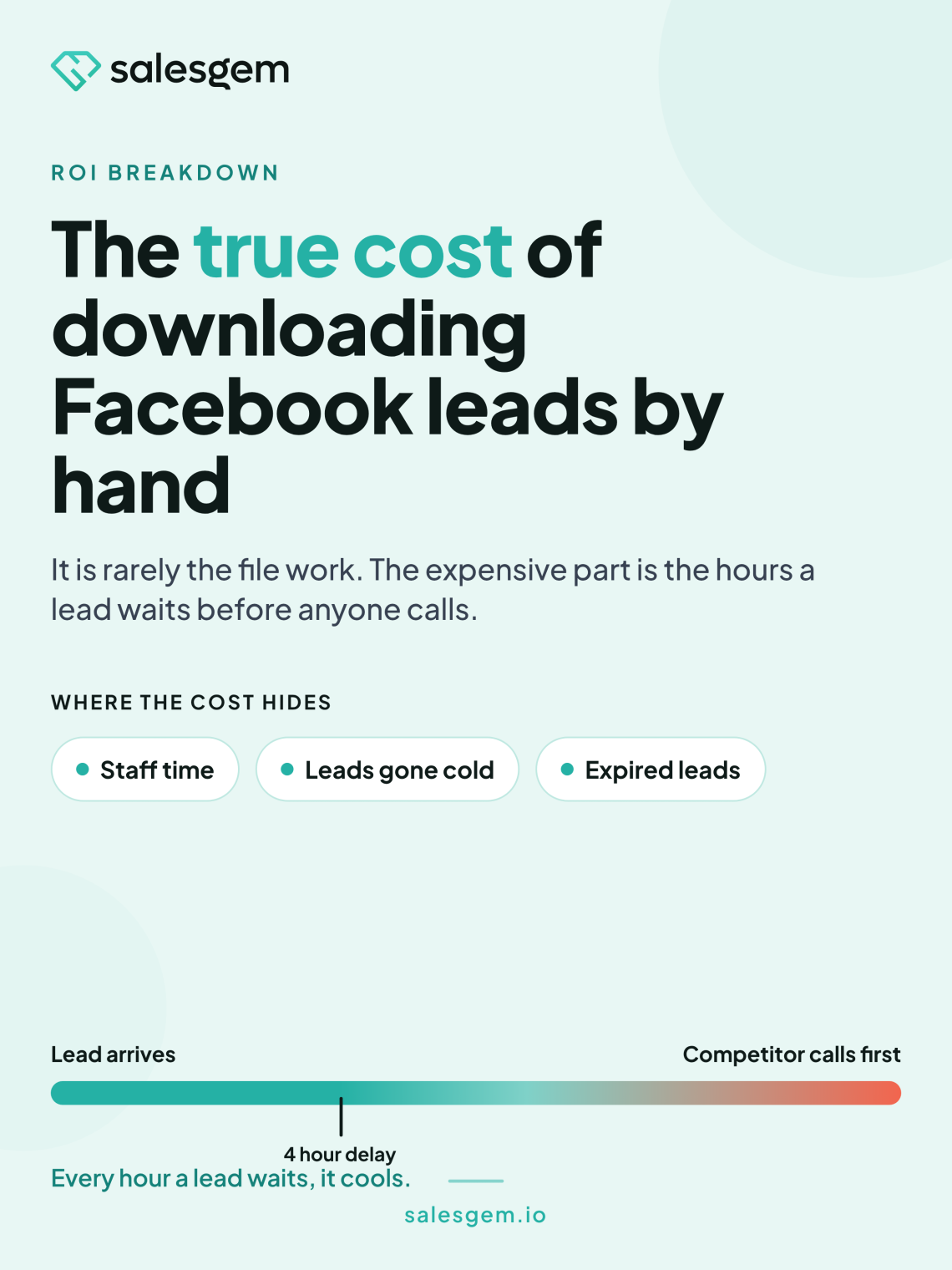
When I mapped the clinic’s process, here is what happened to one enquiry. A patient filled in a form at 10am. The front desk exported leads from Meta at about 1pm, then again near closing time. The file went to the counsellor by WhatsApp. The first call often went out four or five hours after the person first raised their hand.
By then the patient had already spoken to two other clinics. Aesthetic and healthcare enquiries behave like that. People compare, and they book with whoever calls first and sounds calm and clear.
So I added up the real cost. Ad spend was only one line. On top of it sat the staff time spent exporting and sorting, and the revenue lost to slow follow up. The export work was annoying. The response delay was the expensive part.
My advice was simple. Connect the ads straight to a CRM so every lead arrives the moment it is submitted, lands with a named counsellor, and triggers a reminder to call. No file. No waiting. The owner kept the same budget and started booking more consultations within weeks. He never did find a quality problem, because there was not one.
What downloading Facebook leads by hand actually costs
Put numbers on it and the habit stops looking free. Here is an example. Swap in your own figures.
Say you receive 200 Facebook leads a month and someone exports them twice a day. Each export, sort and handover takes about fifteen minutes. That is thirty minutes a day, or more than ten hours a month, spent moving a file around. Price that at your own staff cost and it is a full working day gone, every month, on admin that sells nothing.
Now the bigger line. Say the average lead waits four hours before the first call. Research from Harvard Business Review on online sales leads put a figure on this. Firms that contacted an enquiry within the first hour were nearly seven times as likely to qualify it as those who waited even an hour longer. Against those who waited a full day, the gap widened to more than sixty times. A four hour delay sits well inside the window where most of your paid enquiries have already gone cold.
And that is before a single lead expires. Miss the ninety day window on even a few of those 200 enquiries each month and you have paid for contacts you can now never call.
So take those 200 leads. If faster follow up let you win even a handful more each month, and you know your average sale value, that recovered revenue almost always outweighs the staff hours and the ad spend combined. The cost of downloading Facebook leads by hand is not the download. It is the deals that quietly close somewhere else.
The cost lines owners miss
The full cost of downloading Facebook leads sits in places most owners never add up.
- Staff time on the export and handover, every single working day.
- Leads that go cold because the first call lands hours late.
- Leads that expire. Meta keeps lead data for only about ninety days, then deletes it for good, so any enquiry nobody pulls in time is gone with no way back.
- Duplicate and messy records, because someone exports the same file twice and numbers arrive without country codes.
- Ad spend you cannot judge, because nobody ties closed sales back to the campaign that produced them.
- Owner hours, because the person with ad account access often becomes the one stuck exporting files.
Count those together and a quiet admin job turns into one of the larger costs in the whole sales process.
The solar company that bought more leads and stood still
The second story is a solar company. Good product, strong demand, field teams out on site all day. The office exported Facebook leads to a sheet and pushed them to salespeople over WhatsApp. When enquiries rose, management expected revenue to rise with them, so they bought more leads.
Revenue barely moved. The sales team just got busier and more tired.
I compared lead volume against the time each lead waited for its first contact. The bottleneck was the handover. Some leads got a quick call. Many sat until the next working day, because the field reps only checked the sheet between site visits. Older enquiries were worse. Nobody clearly owned them, so they drifted, and a lead with no owner is a lead nobody chases.
The answer was a connected CRM. It captures each lead on arrival, assigns it to a rep by area, stamps the time it came in, and nudges the rep until the call is made. Suddenly every enquiry had an owner and a clock.
That reframed the whole ROI question. The company stopped asking how many more leads it could buy and started asking how much more it could earn from the leads it already paid for. Same spend, more revenue, calmer team. For a field business, routing by pincode mattered as much as speed, and the manual sheet could do neither.
What this looks like across industries
The pattern changes shape by industry, but the leak is the same everywhere.
In clinics, enquiries are high value and people shop several at once. A hair or skin consultation booked today is lost if the call goes out this evening. The receptionist is usually the one exporting leads between patients at the desk, so the file always waits.
In education and coaching, admission windows create sudden spikes. Parents and students enquire at five institutes in one evening. The first counsellor to call usually wins the seat, and manual exports cannot keep pace during a rush.
In solar and home services, the cycle is long and the team is in the field. Leads need routing by area, and an emailed sheet is stale before the surveyor opens it. The ninety day expiry bites hardest here, because these enquiries often need months of patient follow up.
Different businesses, one root cause. The gap between a lead arriving and a human responding is where the money goes.
What I tell owners to do
After years of these audits, my advice rarely changes.
First, stop treating Meta as your lead database. It was never built to be one, and the ninety day wipe proves it. If you want the longer argument, I wrote about why the sales rep’s phone should not be your CRM separately.
Second, measure your true response time. Pick ten recent leads and check the gap between the form submission and the first real call. Most owners are shocked by what they find.
Third, remove the human from the capture step. A lead should reach the right salesperson the instant it is submitted, with a timestamp and a reminder attached, so nobody has to remember to export anything. That single change ends the habit of downloading Facebook leads by hand.
Do that and the sums change. You stop paying for leads that die in a spreadsheet and start earning from the ones already in your hand. Faster lead follow up grows revenue without a bigger budget, which is the rarest and most welcome thing I can offer a small business owner. Speed moves that number far more than extra spend does.
I am also building a simple ROI calculator so you can run these numbers against your own volume, delay and sale value. That companion page is on the way.
If you want the short version, connect your Facebook and Instagram lead ads to a CRM that captures and assigns every lead the moment it arrives. Salesgem does exactly this. Sign Up and you can connect your ads the same afternoon.
No credit card needed 14 day free trial. Free support and migration
Frequently asked questions
Facebook keeps lead ad data for about ninety days after each form is submitted, then deletes it permanently. You can export leads from Meta Business Suite or your forms library inside that window only. Any enquiry nobody pulls in time is gone with no way to recover it, which is why a direct CRM connection matters so much.
The real cost of downloading Facebook leads is the response delay it creates. Staff spend hours each month exporting and sorting, leads go cold while they wait for a call, and some expire unused. The largest line is almost always the revenue lost when a prospect books with a faster competitor.
Before blaming lead quality, check your response time. Many businesses export leads once or twice a day, so a prospect can wait hours for a first call. Research shows enquiries contacted within an hour are far more likely to qualify than those reached later. Slow follow up is usually the real cause, so fixing response time matters more than changing your targeting.
Connect your Facebook and Instagram lead ads directly to a CRM. A connected CRM captures each lead the moment the form is submitted, assigns it to the right salesperson, records the time, and reminds them to follow up. That removes the export step and closes the gap between a lead arriving and a human responding.
Yes, and it is the cheapest growth lever most small businesses ignore. Faster follow up means more of the leads you already paid for turn into conversations and sales. You recover revenue that was leaking through delay, so the return improves while the budget stays the same.