A lightweight CRM for small business lead tracking is a system a small team can set up in a day. It runs for roughly the cost of a phone plan and works without training. It gives every lead one owner, one visible stage and one follow-up history. Most small teams need exactly that much structure, and very little of what sits above it.
What I saw before I believed any of this
I have spent most of my working life as a sales consultant. Most of that time has been with small teams rather than large sales departments. Clinics, coaching centres, solar dealers, dealership floors, home services companies.
I speak to sales heads almost every week. The same conversation keeps repeating, and it usually arrives at the same question. Which lightweight CRM for small business lead tracking actually works?
It rarely starts with software. It starts with a number that does not add up.
I learned why a lead follow up CRM for small business matters the hard way. At the time I was managing a small sales team running Meta lead ads. We were getting a steady flow of enquiries. The pipeline never matched the number of leads coming in.
At first I thought the team simply was not following up enough. Then I started looking at how a lead actually moved through the business.
The gap nobody had drawn on a whiteboard
A lead would come into Meta Lead Center. Someone would download it or receive an email notification. Then it would get copied into a spreadsheet, or dropped into a WhatsApp group for a rep to pick up. By the time someone noticed the message, the lead could already be an hour old.
The bigger problem was ownership.
Two reps sometimes contacted the same person. Other leads sat untouched because everyone assumed someone else was handling them. I could not quickly see who had called. Contacted leads and forgotten leads looked identical on my screen.
So the honest diagnosis was this. My team was working hard inside a process that leaked. For a small business, the best lightweight CRM for small business lead tracking is the one that removes these gaps. It should not create another complicated system for the team to maintain.
When the pipeline disappeared into WhatsApp
Another problem became obvious when more of our reps started moving conversations to WhatsApp.
From the rep’s perspective, it made perfect sense. They could call the lead, send a message, share a brochure, and continue the conversation from their phone. But from my perspective as a sales manager, the pipeline was disappearing into individual phones.
I could not reliably tell which leads were being followed up. Cold conversations were invisible. So was the reason a booked consultation never happened. If a rep went on leave, nobody else knew what had been discussed with that lead.
I also started seeing duplicate contact. One rep would message a lead on WhatsApp while another called the same person. Neither had a clear view of the latest activity. This is the same failure I later wrote about in why your sales rep’s phone should not be your CRM.
I did not need a complicated system to fix this. I needed one record per lead, one owner, a visible stage and a history of follow-ups. Reps could keep using the channels they liked.
That experience changed my definition of a lightweight CRM for small business. It is not about having the longest feature list. It is about enough structure to know who owns each lead, what happened last, and what happens next.
What “lightweight” actually means
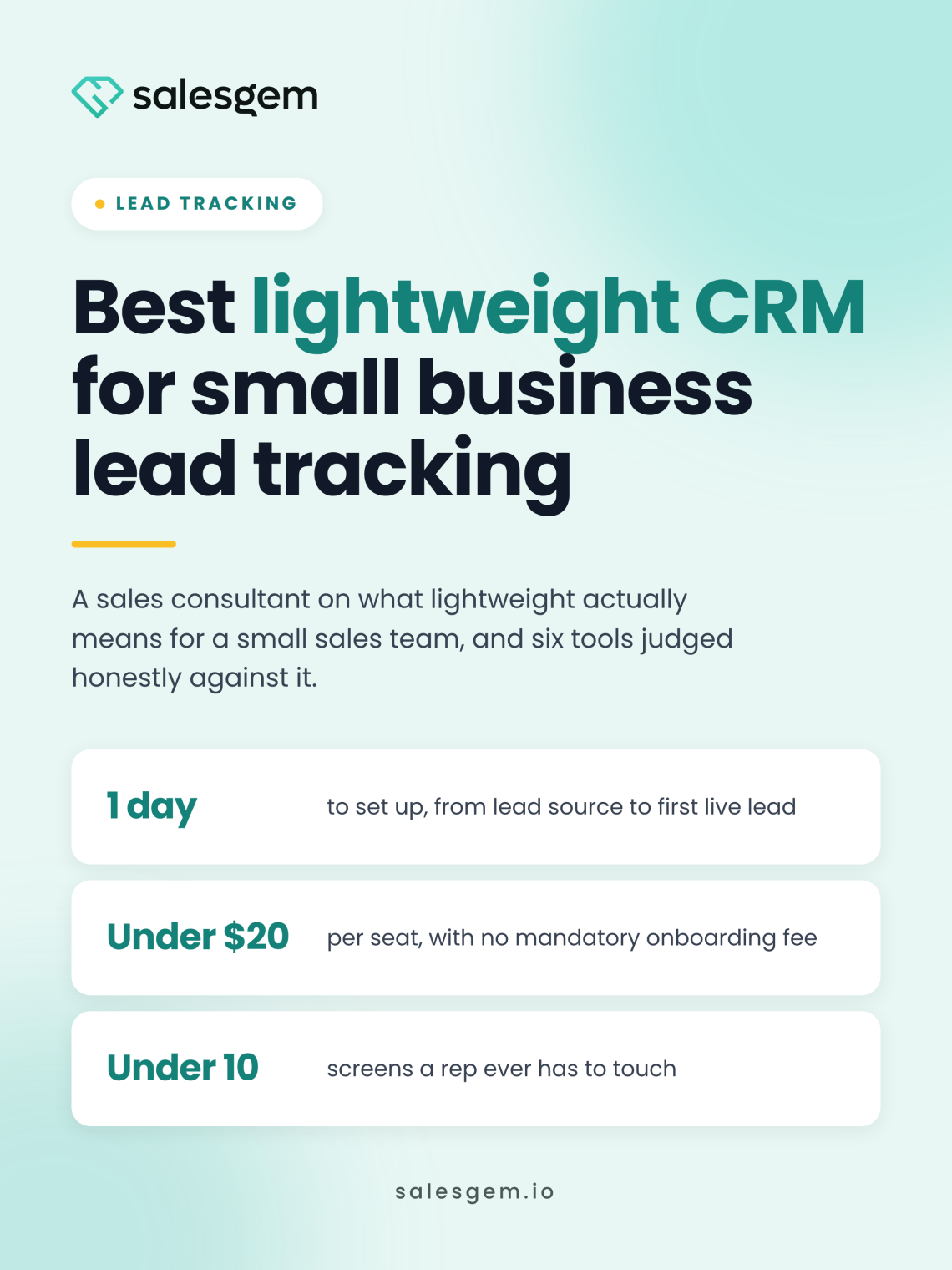
Most buyers use the word loosely when they shop for a lightweight CRM for small business. After watching dozens of small teams adopt and abandon tools, I now hold vendors to three concrete numbers.
Setup time under one working day. A sales head should connect a lead source, add reps, and receive a live lead before going home. If the tool needs a consultant or a two week implementation, it is not lightweight for a five person team.
Entry price under roughly 20 US dollars per user per month, with no mandatory onboarding fee. Small teams pay per seat out of operating cash. A compulsory implementation charge is a bigger warning sign than the subscription itself.
Fewer than ten screens a rep ever has to touch. Count them during the trial. If a rep needs more than a handful of places to do the daily job, adoption fails quietly. The team drifts back to WhatsApp.
Those three thresholds cut most of the market away, which is the point.
What small teams skip in the bigger tools
HubSpot comes up in almost every conversation about a lightweight CRM for small business, so it deserves a fair hearing.
The free tier is genuinely useful for contact and deal tracking. Free accounts are capped at two users and one deal pipeline. Accounts created after September 2024 store as few as 1,000 contacts. Paid tiers begin around 20 US dollars per seat per month on the Starter bundle.
The jump after that is where small teams get hurt. Sales Hub Professional runs about 90 US dollars per seat per month on annual billing, or 100 billed monthly. Year one also carries a required one time onboarding fee of 1,500 US dollars.
Here is what small teams never switch on after paying for it. Custom report builders, forecasting, lead scoring, sequences, ticketing, quote workflows, marketing contact tiers. Those exist for companies with a marketing operations person. A clinic with four reps has no such person.
So the cost is not only money. Every unused module is another screen a rep walks past before logging a call.
Six tools worth shortlisting
I have ranked nothing here. The order below carries no scoring. Each tool is grouped by the job it does well, with the place it falls short. Salesgem sits first because this is its blog and I would rather declare that than bury it in position five. Every option qualifies as a lightweight CRM for small business on at least two of my three thresholds. Pricing was verified in September 2026 and changes often, so confirm on each vendor’s own page before buying.
Salesgem
Read this entry knowing whose site you are on. Salesgem runs at 15 US dollars per user monthly, or 12.45 on annual billing. Facebook and Instagram Lead Ads arrive over a webhook instead of a CSV download, each lead is auto assigned to a named rep, and follow up carries on over the official WhatsApp Business API while the record stays in the pipeline. Android and iOS apps both exist. Meta Conversions API is included.
Where it falls short: the wedge is Meta and WhatsApp inbound. If your leads come from Google Ads, website forms or cold outbound, a general pipeline tool serves you better. There is no bulk broadcast, no chatbot builder and no commerce catalogue.
Zoho Bigin
Bigin is the closest thing to a default answer for a small team that wants a real pipeline cheaply. It offers four tiers at 0, 7, 12 and 18 US dollars per user monthly on annual billing. There is no minimum seat requirement. Pipelines, stages, mobile apps and basic automation arrive without configuration work.
Where it falls short: the free tier is single user, so a second rep means paying. Reporting stays basic, and several capabilities arrive as paid add-ons.
Less Annoying CRM
One plan at 15 US dollars per user per month, with every feature included. No contracts, no tiers, and a 30 day free trial. This suits a two person team that needs contacts, notes and a follow up nudge. It is the least painful option I know.
Where it falls short: no free tier, and limited automation. It suits relationship tracking more than high volume inbound lead flow.
Capsule CRM
Capsule has a free plan covering 250 contacts and up to two users. Paid seats start at about 18 US dollars per user monthly on annual billing. Contact limits are the main reason teams move up a tier, which makes budgeting predictable.
Where it falls short: marketing email needs a separate paid add on. Paid ads fill the free tier’s contact cap quickly.
Pipedrive
Pipedrive runs four plans from 14 to 79 US dollars per user monthly on annual billing. Month to month billing raises that range to 24 through 99. There is no permanent free plan, though a 14 day trial applies. Reps understand the drag and drop pipeline within minutes.
Where it falls short: workflow automation sits above the entry tier. The add on menu can quietly double a small team’s bill.
Privyr
Privyr is built around the pain I described earlier, which is reps working leads from a phone. The free tier covers up to three team members. It only lets you engage and track your most recent lead. The paid tier covers up to 20 members and adds follow up sequences and Meta Conversions API. Privyr is a verified Meta Business Partner.
Where it falls short: lead distribution by email or WhatsApp costs 0.10 US dollars per lead. The WhatsApp auto responder, campaigns and sequences are paid add-ons.
How this plays out by industry
A lightweight CRM for small business has to fit the shape of the selling day. The same leak looks different depending on who is selling.
Clinics. Front desk staff own callbacks while checking in walk-in patients. Leads get deprioritised during exactly the hours the clinic could see them. Prospects usually enquire at two or three clinics for the same procedure. The first real conversation often wins the consultation.
Education and coaching. Admission windows create sharp spikes. Counsellors handling a trickle suddenly handle fifty enquiries a day. The funnel then runs over weeks through enquiry, session, demo and enrolment. A spreadsheet records who enquired, never where they stopped.
Solar. Consideration runs three to six weeks with a dozen touchpoints. Manual cadences collapse over that timeline, because somebody has to remember the right callback window for forty households at once.
Home services. The enquiry is often urgent, and loyalty is thin during a breakdown. Reps work from vans, not desks, so mobile access decides whether the tool gets used at all.
Dealerships and insurance. Floor reps compete for the same inbound enquiry, which creates friction unless assignment is automatic. In insurance, the follow-up trail also has to survive a compliance review. A personal WhatsApp thread will not do that. A CRM with WhatsApp integration keeps the record where an auditor can find it.
What I would tell you after all of this
Three pieces of advice, learned the expensive way.
Start from your leak, not from a feature list. Draw the path a lead travels today, from form submission to the moment a rep dials. The gaps on that drawing are your requirements. Everything else is somebody’s marketing. This is also the fastest way to shortlist a lead follow up CRM for small business without sitting through six demos.
Trial with your slowest adopter, not your best rep. Your top performer will make any tool look good, because a strong rep works the pipeline whatever the software does. The quiet rep who still keeps notes on paper is the real test. If the tool survives that week, it will survive your team.
Measure one thing for thirty days before you judge it. Track the time between lead arrival and first contact attempt, then set a cadence around it. The research here is old and still holds. Work from InsideSales.com found a sharp cliff in the first few minutes. The odds of a lead entering the sales process were 21 times greater at five minutes than at 30 minutes. A separate Harvard Business Review study looked at 1.25 million leads. Firms making contact within the hour were nearly seven times as likely to reach a decision maker.
I declared my bias in the shortlist and I will leave it there. If the leak you drew looks like the one I drew, sign up for the free trial and hold it to the same three thresholds you would apply to anything else on that list.
Frequently asked questions
A lightweight CRM for small business lead tracking captures leads, assigns an owner, shows a stage and records follow-ups. It leaves out the modules a small team will never use. Three tests apply: setup inside a working day, an entry price near 20 US dollars per seat, and under ten screens a rep touches daily. Anything heavier belongs to a different category of buyer.
Most small teams should budget 7 to 20 US dollars per user per month for a lightweight CRM for small business. Entry tiers from Zoho Bigin, Capsule and Pipedrive sit inside that band on annual billing. Less Annoying CRM charges a flat 15 US dollars for every feature. Treat any mandatory onboarding fee as a signal the product was built for larger companies.
A free CRM is enough while you have one or two people and low lead volume. Free tiers cap users tightly. HubSpot limits free accounts to two users, and Capsule to two users and 250 contacts. Once a third rep joins, lead assignment and follow-up history become the things you are actually paying for.
Yes, because WhatsApp holds conversations, not ownership. Without a record layer, a manager cannot see which leads were contacted or which went cold. Nothing survives a rep going on leave. The workable setup keeps reps messaging on WhatsApp. Every lead still carries one owner, one stage and one follow-up history.
For a small team, under one working day. Connecting a lead source, adding users, and receiving a live test lead should happen in a single sitting. Anything needing a consultant or a multi-week implementation belongs to a heavier category of product. The entry price on the pricing page does not change that.