Lead response time statistics 2026: what the data says about calling first
Lead response time statistics keep saying the same thing in 2026: the business that calls first usually wins. Research shows a reply within five minutes makes you far more likely to reach and qualify a lead than a reply thirty minutes later. I saw that pattern on the sales floor for years before I read a single study about it.
Over the past five years I have worked with clients across several industries and stayed in close contact with other sales experts. The lesson that stuck was simple. Speed to lead is not another number on a dashboard. It decides how much of your marketing money turns into real conversations. For the workflow side of this, our guide to lead follow up for small business walks through how the process should run.
What I learned on the sales floor
When I worked inbound leads, the biggest difference was rarely the quality of the lead. It was how fast someone picked up the phone. A lead I called within minutes still felt engaged. They asked questions. They wanted to talk. Leave that same lead for a few hours and often nobody answered at all.
What surprised me most was how little most businesses changed because of this. Leads sat in inboxes, spreadsheets, and notification queues. Reps followed up when they got around to it. By then the buyer had already spoken to someone else.
So I stopped treating slow follow up as a sales problem. I started treating it as wasted acquisition spend.
What the lead response time statistics actually say
The research backs up what I watched happen every week. Here is the roundup, with dates, so you can weigh each figure for yourself.
The five minute window
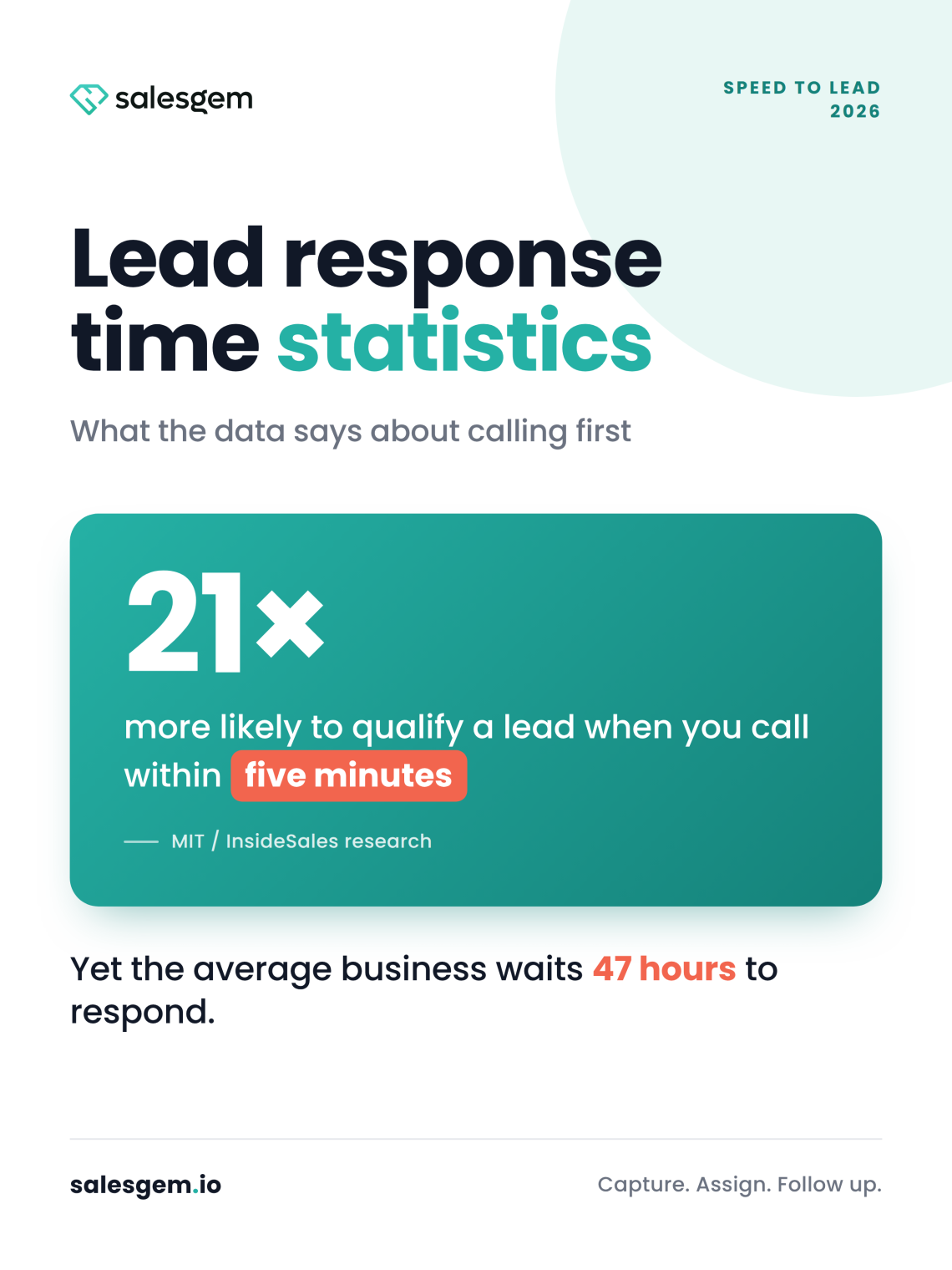
The original MIT and InsideSales research found that contacting a lead within five minutes made a company roughly 100 times more likely to make contact, and about 21 times more likely to qualify the lead, than waiting thirty minutes. That study looked at tens of thousands of leads, and it is still the most quoted number in the field.
Newer 2026 benchmarks push the target lower. Several reports now treat under one minute as the ideal, and Velocify research is cited for a sharp jump in conversion when a lead is contacted inside the first sixty seconds.
The one hour cliff
Harvard Business Review research found that companies replying within an hour were seven times more likely to qualify a lead than those who waited longer. A recent 2026 study of more than nine hundred companies found a 32 percent close rate for leads contacted within five minutes, against 12 percent for leads contacted a day or more later.
How rare fast response really is
Here is the gap that still surprises me. Across industries, most companies respond slowly or not at all. Studies put the average first response at around 47 hours, and a large share of companies never reply to an inbound lead. Only a small fraction reach a lead inside five minutes. The data has been clear for years, yet the behaviour has barely moved.
One honest note. Many of the headline figures trace back to studies from 2007 and 2011 that get requoted everywhere. The math still holds up against newer audits, but read any single stat with its date in mind.
Why this is really an ad spend problem
Think about what a slow reply does to your budget. You pay to generate a lead. Then you take hours to call. By then the lead is colder and less likely to convert. You paid full price for a fraction of the value.
The industry math makes this plain. If you pay around $40 for a lead and wait a day to reply, that lead can be far less likely to convert than one you called in five minutes. In real cost per customer terms, you turned a cheap lead into an expensive one.
In my experience, getting reps to respond fast often beats spending more to generate another batch of leads. Same budget, more conversations, more sales. That is why I now push clients to capture Facebook Lead Ads straight into a system that reaches the rep at once, rather than pulling CSV files by hand. Meta itself recommends an integrated system over manual downloads, because downloading leads by hand adds delay and can lower lead quality.
What our own platform data showed
I did not want to lean only on outside studies, so I looked at Salesgem’s own numbers. The pattern held. The longer a business took to make the first call, the lower the lead quality trended. The faster the call, the more qualified the lead. In the data I reviewed, faster follow up lined up with a sales lift of about 60 percent.
Where I see this hurt businesses most
The pain is not spread evenly. A few industries feel it hardest, and they are the ones running high volumes of paid leads.
Aesthetic and healthcare clinics are the clearest example. Healthcare carries one of the slowest average response times of any industry, often around two hours, while the ideal window sits under ten minutes. A single patient can be worth thousands over time, so every missed inquiry is real money walking to a competitor.
Car dealerships show the same story. Dealers who reply inside five minutes are far more likely to reach the buyer than those who wait thirty. Most sales teams sit in a twenty five to forty minute band, which feels normal and quietly loses deals.
Home services, from solar to roofing, buy leads by the piece. A cheap lead answered in five minutes has a very different return than the same lead answered thirty minutes later. The offer is identical. Only the speed changed.
My advice after years of watching this
If I could give a business one instruction, it would be this. Measure your response time before you spend more on ads. Most owners have no idea what their real number is, and it is almost always slower than they think.
Then remove the human delay. A rep who has to notice a lead, open a file, and decide to call will always be slower than a system that puts the lead in front of them the moment it arrives. Route each lead to one named owner, so nobody assumes someone else has it. If you want the full follow up method, our lead follow up for small business guide lays it out step by step.
Speed to lead is the cheapest growth lever most businesses never pull. You already paid for the lead. Answer it while the person still wants to talk. When you are ready to fix the follow up side properly, you can sign up for Salesgem with no credit card needed, a fourteen day free trial, and free support and migration.
Frequently asked questions
A good lead response time in 2026 is under five minutes, and the strongest teams aim for under one minute. Research shows a reply within five minutes makes contact far more likely than a reply after thirty. For paid leads from Facebook and Instagram, faster is always better, because that interest fades within minutes of the form being sent.
Calling first matters because most buyers contact several businesses at once. The first company to reply usually starts the real conversation and often wins the deal. Later callers reach a person who has already spoken to a competitor. Speed does not just improve your odds a little. It changes who gets the sale.
Slow lead response quietly wastes a large share of ad spend. When you pay to generate a lead and take hours to reply, that lead converts at a much lower rate. Some estimates suggest slow follow up can waste forty to sixty percent of a lead budget. The loss rarely shows in any report, so it looks like a lead quality problem instead.
Many quoted figures come from studies published in 2007 and 2011, so treat them with their dates in mind. Newer audits from recent years test the same idea and reach similar conclusions. The direction stays consistent across every study. Faster response improves contact and qualification, even as the exact numbers shift over time.
Businesses that run high volumes of paid leads lose the most. Clinics, car dealerships, and home service companies feel it hardest, because each lead is expensive and the buyer is ready now. When these businesses reply in minutes rather than hours, more of their marketing spend turns into booked customers.