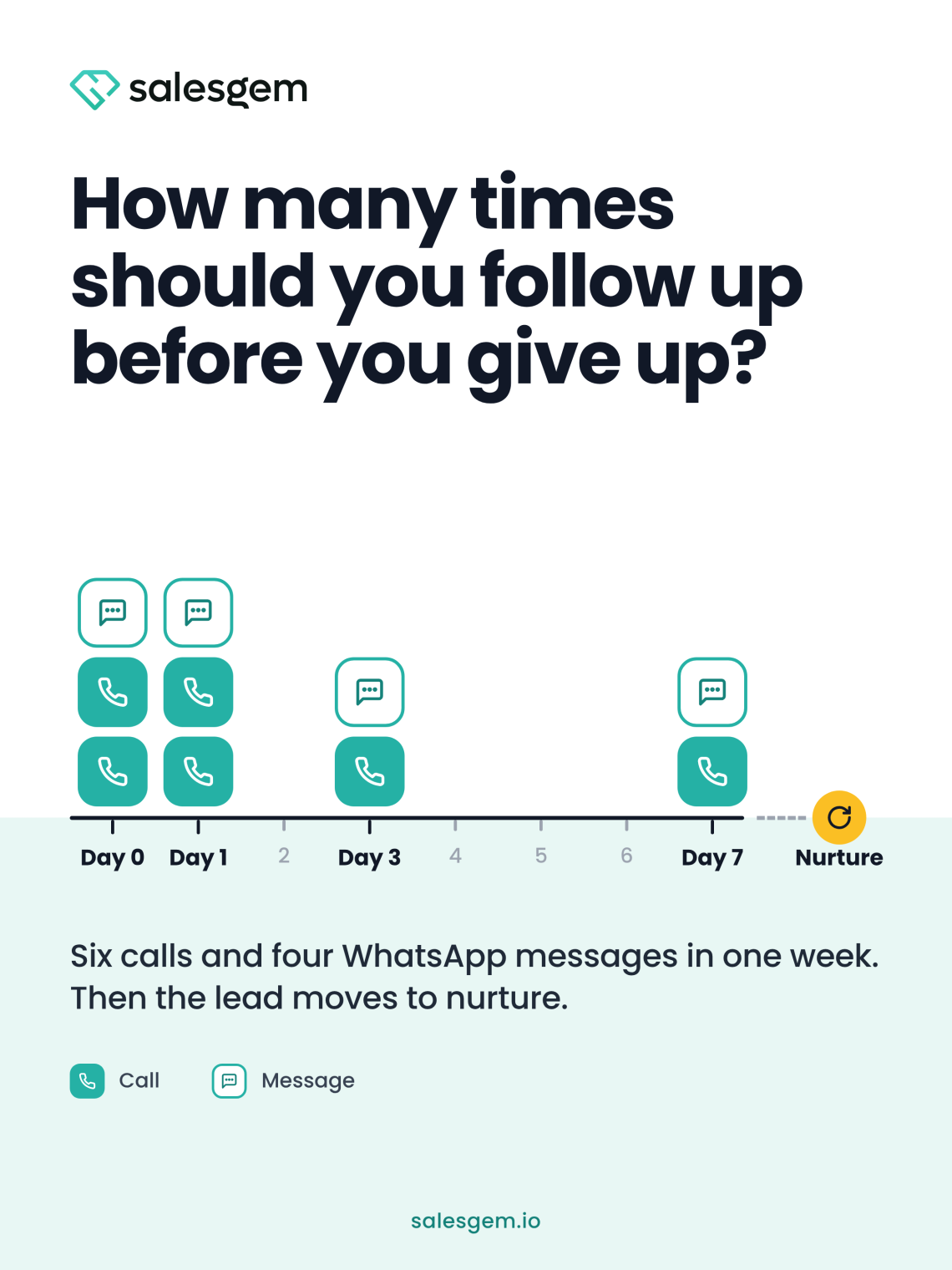
A good lead follow up time gives each new lead six call attempts and four WhatsApp messages. Spread them across day 0, day 1, day 3 and day 7, then move the lead to nurture. The exact number matters less than the system behind it. On most teams I’ve worked with, leads die long before anyone reaches attempt six.
I’ve worked as a sales consultant for more than ten years. My clients have included clinics, schools, solar installers, home service companies and car dealers. Owners ask me this question more than almost any other. When I dig in, the real issue is visibility. Most teams can’t say how many times a lead was actually contacted, so they can’t decide when to stop. If follow-up still runs on memory, a lead follow up CRM for small business is the first fix. The cadence comes second.
The day “three or four” turned out to be one call
I remember spotting a pattern in one team’s sales report. The team ran Facebook lead ads, and reps called new leads quickly. Older leads, though, were quietly dying.
Every morning, the reps wanted the fresh leads because they felt easier to close. Yesterday’s leads had already missed one call. So they kept sliding down the list.
I asked one rep how many times he’d followed up with an older lead. “Probably three or four,” he said. Then I checked the call history. It showed one actual call. The rest were messages or missed attempts that nobody had logged.
Those leads were slipping away without anyone deciding to drop them. Follow up depended on memory, personal call logs and whichever leads a rep felt like calling that morning. It’s the same problem behind why your sales rep’s phone shouldn’t be your CRM.
So we moved the process into a CRM. It assigned every new lead to a rep automatically. Each call and message sat on the lead’s record. When a lead didn’t respond, the CRM created the next follow-up task, so nobody had to remember it. We also set a rule for when an untouched lead moves to another rep.
The same reps simply stopped forgetting leads. As a manager, I could finally see how many attempts each lead had received, including the ones nobody had touched. That made it much harder to call a Facebook campaign “low quality” when half its leads had never received consistent follow-up.
The rep who called four times in one afternoon
The opposite problem came from one of my more aggressive reps. He believed an unanswered Facebook lead just needed more calls. Four calls in one afternoon wasn’t unusual for him. After the last missed call, he’d send a WhatsApp message too.
Nobody else could see any of that. The next day, another rep might pick up the same lead and send another message. In my report, it looked like persistence. To the customer, it could look like one company chasing them from different numbers.
That’s when I realized we needed limits as much as we needed a process.
We moved those leads into a CRM with a defined lead follow-up cadence. Before every attempt, the rep saw the full contact history: calls, WhatsApp messages, earlier notes and the last response. The CRM scheduled each follow-up, so personal memory stayed out of it. Leads that reached the end of the cadence moved into a nurture or closed stage. Nobody chased them indefinitely.
That gave the team something it never had before: a clear answer to “should I contact this person again?”
It helped me as a manager too. I could check whether reps gave leads enough chances without pushing anyone to call endlessly. I stopped counting how often people said they had “followed up.” Instead, I measured the actual sequence of attempts and outcomes.
The CRM didn’t make the team call more. It made every follow-up deliberate.
What the data says about contact attempts
You’ve probably seen the claim that 44% of salespeople give up after one follow-up. I’d stop repeating it. Some pages credit it to Yesware, others to The Marketing Donut or a National Sales Executive Association. The original study behind it is hard to find.
The attempt data I trust comes from Velocify’s Ultimate Contact Strategy study. It covers nearly 3.5 million leads from more than 400 companies. All of those leads came in during the first half of 2012.
| What the study measured | Finding |
|---|---|
| Converted leads first reached after the first call attempt | More than half |
| Converted leads reached by the sixth call attempt | 93% |
| Leads that needed seven or more calls to reach | 45% less likely to convert |
| Leads never called a second time (earlier Velocify research) | 50% |
| Leads also sent emails between calls | 16% higher chance of phone contact |
| Leads sent more than five emails before contact | 36% lower conversion rate |
So the data cuts both ways. Stop after one call, and you miss more than half the leads that would have converted. Keep calling past six, or flood a lead with messages, and each extra attempt returns less.
Two caveats before you copy it. This is phone and email data from 2012, before WhatsApp became the main follow-up channel for many businesses. The study also warns that the best approach for one industry can differ from its overall average. That’s why I adjust my lead follow up cadence by industry further down.
The lead follow up cadence I recommend: day 0, 1, 3 and 7
This is the pattern I set up with most teams now. It holds calls at six and spreads them across a week, so the lead notices you without feeling hunted.
| Day | Calls | WhatsApp messages | Goal |
|---|---|---|---|
| Day 0 | 2 | 1 | Reach them while the inquiry is fresh |
| Day 1 | 2 (morning and evening) | 1 | Try the hours they’re actually free |
| Day 3 | 1 | 1 useful message | Give them a reason to reply |
| Day 7 | 1 | 1 closing message | End the active chase |
On day 0, call as soon as the lead comes in. Timing matters most here, so read up on how fast you should respond to a new Facebook lead. If they don’t answer, send a short WhatsApp message with your name and the offer they asked about. Instant form leads often forget which business they contacted. Try one more call later that day, at a different hour.
On day 1, call twice: once in the morning and once in the evening. Plenty of leads fill forms at night or on weekends, then spend office hours at work. If neither call connects, send a second message that’s shorter than the first.
On day 3, call once. If there’s no answer, send something useful instead of another “just checking in.” A clinic might share this week’s open consultation slots. A solar installer might send a rough cost range for a typical home.
On day 7, make the final call. Then send a closing message that takes the pressure off. Say you’ll stop calling, and that they can reply whenever they’re ready. A quiet lead now has an easy way back.
That’s six calls and four messages, matching the six call point in the Velocify data.
How to keep the cadence honest
A lead follow up cadence only works when the whole team runs it the same way. Log every attempt against the lead, including missed calls and unanswered messages. Check the full history before each touch, so two reps never message one person on the same day. Stop the cadence the moment a lead replies. And decide in advance what happens on day 8.
Day 7 ends the active chase. After that, the lead moves to a nurture stage, where contact is slower and tied to a reason. That reason might be a new offer, a seasonal change, an intake date or a price update.
A lead marked “dead” is gone for good. A lead in nurture can come back months later, and in some industries that’s when people buy. Nurture also keeps your pipeline honest. When stale leads sit in “open,” the pipeline looks full and the forecast is wrong.
Rules that limit your lead follow up cadence
Some limits come from outside your team. On the WhatsApp Business API, a message you start must use a template that Meta has approved. Free form replies only work within 24 hours of the customer’s last message. Meta also limits how many marketing templates one person can receive in a day. A cadence that fires WhatsApp messages every few hours may simply fail to deliver.
Phone calls have limits too. Several US states, including Florida and Oklahoma, cap telemarketing calls on the same subject at three in 24 hours. In India, TRAI rules control which numbers businesses can use for promotional calls. Whether these rules cover a callback to someone who filled your form depends on the law and the situation. Check with someone who knows your market before you set daily call targets.
How lead follow-up cadence changes by industry
The day 0, 1, 3 and 7 pattern is a starting point. Interest fades at very different speeds across industries, so the gaps between touches should change too.
Aesthetic and healthcare clinics
Clinic inquiries are personal. Someone asking about hair loss or a cosmetic procedure may not want family or colleagues to notice repeated calls. I lean on WhatsApp here, with wording that doesn’t name the treatment in the first line.
The bigger leak comes after the price. A lead asks what it costs, reads the reply and goes quiet. Many front desks stop there, yet that’s exactly when the day 3 and day 7 touches matter most. Booked consultations need their own short lead follow up cadence too, because some patients never show up.
Education and coaching
The student often fills the form, while a parent often pays. Many students reply to WhatsApp faster than they answer calls, so message heavy touch days work well. Prospective students also tend to inquire with several institutes at once. That makes day 0 and day 1 even more important. Intake deadlines give you a natural end date, and quiet leads can move to nurture for the next intake.
Solar installation
Solar decisions take months and often involve a spouse, a landlord, a housing society or a lender. A seven day cadence has a narrower job here: reach the lead and book a site survey. The harder follow up starts after the quote, when the lead has a number and plenty of questions. Give the post quote stage its own lead follow up cadence, with longer gaps between touches.
Home services
Home services sit at the other extreme. Someone with a broken AC or a leaking pipe usually hires whoever answers first. Here, most of the cadence happens on day 0, with calls and a message spread across the first few hours. By day 3, the job has often gone to someone else. After that, a seasonal reminder like a pre-summer AC service will do more than another call.
Automotive dealerships
Car buyers often inquire with several dealers about the same model. A plain “just following up” blends in with every other dealer’s message. Give each touch a reason, like a test drive slot or a finance option they asked about. Booked test drives also need a reminder cadence, since a missed test drive often means the buyer went elsewhere.
Fitness and wellness
Fitness leads arrive in waves, often around the new year or before summer. The motivation behind them fades quickly, so keep day 0 and day 1 tight. Free trial no shows are the bigger leak. Add a short cadence between the booking and the first session. Leads that go quiet are worth another try at the next seasonal spike.
What I tell every team about follow-up
After ten years of watching leads slip, this is the advice I give most often.
Count logged attempts. A rep’s memory of “three or four” can hide a single call.
Put your lead follow-up cadence inside the system your reps open every day. A rule that only lives in a training deck gets forgotten fast.
Set a reassignment rule for untouched leads. Otherwise, fresh leads will bury old ones every morning.
Treat six calls as the ceiling for the active stage. Past that point, each extra call returns less.
Before you blame your Facebook leads for poor quality, check how many of them actually reached day 7.
If your team runs Facebook and Instagram lead ads, Salesgem is built for this part of the job. It captures each lead, assigns it to a rep automatically and keeps follow up tasks and WhatsApp conversations with the lead. That way, the next attempt never depends on someone’s memory. See how a lead follow up CRM fits a team like yours, or Sign Up and try it with your own leads.
No credit card needed · 14 day free trial · Free support and migration
Lead follow-up cadence FAQs
A good lead follow-up cadence spreads six calls and four WhatsApp messages across day 0, day 1, day 3 and day 7. It allows two calls a day at most and changes the time of day between attempts. After day 7, the lead moves to a slower nurture stage and stays in your records for later contact.
You should follow up with a lead about six times by phone before ending the active chase. Add WhatsApp messages between calls. Velocify’s study of nearly 3.5 million leads found that 93% of converted leads were reached by the sixth call. Leads that took seven or more calls to reach were 45% less likely to convert.
You should stop following up with a lead when your cadence ends or when the lead asks you to stop. In the pattern above, active follow-up ends on day 7. After that, move the lead to nurture. Contact it again only when you have a real reason, like a new offer or an intake date.
You should call and WhatsApp to follow up with a lead, because each channel reaches people at different moments. Calls work when someone can talk now. WhatsApp reaches people who can’t pick up at work. On the WhatsApp Business API, any message you start needs an approved template, so prepare those messages in advance.
Sales reps stop following up with older leads because new leads feel easier to close. Older ones have already missed a call. When follow-up depends on memory and personal call logs, older leads keep sliding down the list. Scheduled follow-up tasks and a reassignment rule for untouched leads fix most of this.