B2C vs B2B CRM: why lead speed matters more when your buyer is a person
I have spent more than ten years fixing follow up for sales teams. Some sold to businesses. Some sold to consumers. Watching both taught me the lesson I now repeat to every client. A B2C CRM and a B2B CRM both organize leads and track deals. The real B2C vs B2B CRM difference is not the feature list. It is how fast the buyer’s interest fades. In B2C, a lead left for an hour is often already gone.
Two CRMs built for two very different clocks
Early in my career I ran a small experiment across two clients. One sold industrial equipment to procurement teams. One sold cosmetic treatments to walk in consumers.
The B2B client had a CRM full of long pipelines. Deals moved across weeks, sometimes months. Several people signed off before any money changed hands. Their CRM earned its keep by keeping a slow, complex process organized.
The consumer client had none of that. One person saw an ad, felt something, and filled a form. There was no committee. There was no second meeting booked by default. If nobody called that afternoon, the person went elsewhere.
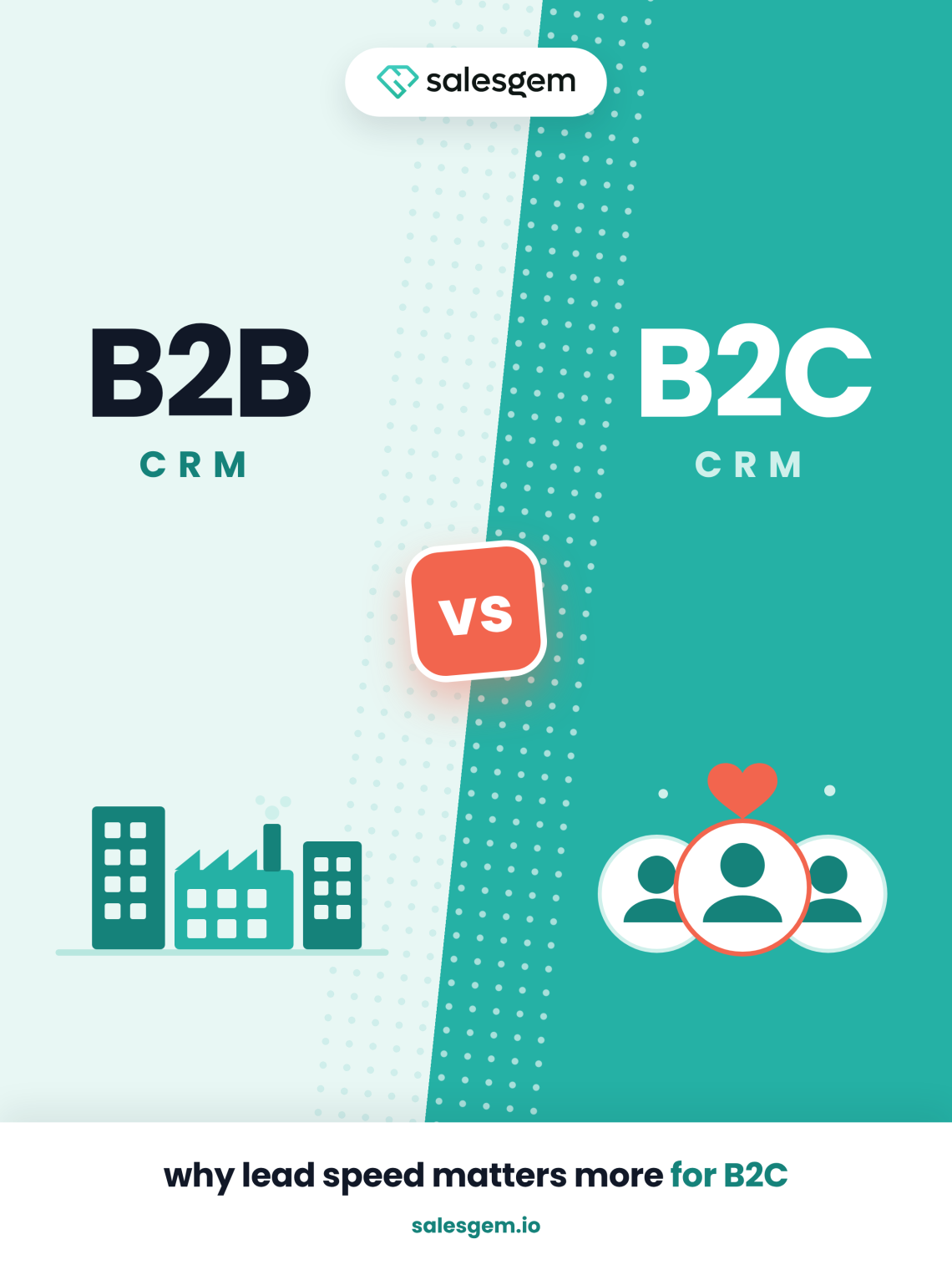
Same category of tool. Completely different job. A B2B CRM manages a long conversation. A B2C CRM protects a short window.
Why lead speed matters in both B2B and B2C
Speed helps everywhere. I have never seen a team lose deals by responding too fast.
The research backs this up. The MIT lead response study led by James Oldroyd found that the odds of qualifying a lead drop sharply after the first few minutes. Harvard Business Review reported similar findings in “The Short Life of Online Sales Leads.” Firms that reached buyers within the first hour were far more likely to qualify them than firms that waited longer.
In B2B, that speed wins you the first meeting. Being the first vendor to reply puts you ahead of the evaluation. It still matters. It just does not decide the whole deal, because the buyer’s problem is still there next week.
Why speed matters more for B2C
Here is where the two worlds split.
B2C intent is emotional and short lived. Someone fills an ad at night because they feel a certain way in that moment. By morning the feeling cools.
B2C buyers also shop in parallel. They fill three or four forms in one scroll. The first business to call gets the live conversation. The rest reach voicemail.
There is usually one decision maker. That person can say yes on the spot, so a fast call can close, not just open.
And the speed itself sends a signal. A consumer choosing about their face, their money, or their home reads a quick human callback as proof the business is real. A slow reply reads as risk.
What this looks like across industries
I have watched this pattern repeat across every consumer vertical I have worked in.
In aesthetic and healthcare clinics, the front desk is busy with patients in the room. Web leads pile up unworked while a competitor clinic, one scroll away, answers first. The booking goes to whoever replied. I broke this down further in a piece on how aesthetic clinics convert Facebook leads into consultations.
In coaching and education, enrolment runs on a motivation spike. Call within the hour and you catch it. Call the next day and the student has moved on.
In solar, the same homeowner often fills forms for several installers at once. Reps are out on site surveys, not at a desk. First to reach the phone books the visit.
In insurance, comparison shopping is the entire game. People request several quotes and buy from the first agent who reaches them and earns trust.
The follow up failures I see again and again
The tools are rarely the whole problem. The gaps around them are.
Leads sit unseen in a lead centre or a downloaded file for hours, which is exactly why Facebook leads go cold before anyone works them.
Nobody owns the lead. It lands in a shared inbox, so two reps call the same person or nobody does.
The CRM was built for a desk. The rep is on the clinic floor or in the field, and the lead never reaches their phone.
Ads run all night. The buyer browses at 10pm. The rep is offline until Monday.
The customer answers WhatsApp, not an unknown call. Teams working calls and email alone get ignored.
Then everyone blames lead quality, when the real issue was a delay nobody measured.
What I tell every B2C team
After ten years, my advice is simple.
First, measure your response time. Most teams have no idea what theirs is. You cannot fix what you do not track.
Second, get the lead to a phone the moment the form is submitted. Not to a dashboard someone checks later. To the assigned rep, in real time.
Third, assign ownership automatically. Every lead has one name against it before it goes cold.
Fourth, follow up on the channel the customer actually uses. For most B2C markets now, that includes WhatsApp.
This is the job a B2C CRM should do. It is why we built Salesgem to capture Facebook and Instagram lead ads the moment they arrive, route each one to the right rep’s phone, and open a WhatsApp follow up while the lead is still warm. A B2B CRM can hold a long deal together. A B2C sale needs the opposite. It needs speed.
If you sell to consumers and follow up speed is your leak, you can try it yourself. Sign Up at salesgem.io/signup.
No credit card needed · 14 day free trial · Free support and migration.
Frequently asked questions
A B2C CRM is built for high volume and fast follow up, where one consumer decides quickly. A B2B CRM is built for long pipelines and buying committees, where deals move over weeks or months. Both track leads and deals. The B2C version prioritizes speed to the lead, while the B2B version prioritizes organizing a slow, multi person process.
Consumer intent fades fast. A B2C buyer often fills several ads at once, in an emotional moment, with no second meeting booked. The first business to reply gets the live conversation and the sale. In B2B, the buyer has a lasting business problem and a committee, so a slower reply still has a real chance to compete.
Yes, if you run paid ads or handle more than a handful of leads a week. Leads from Facebook, Instagram, or WhatsApp arrive faster than one person can track by hand. A lightweight B2C CRM captures each lead, assigns it, and reminds you to follow up before it goes cold. A spreadsheet cannot do that in real time.
How fast should you follow up with a Facebook or Instagram lead?
As close to the moment the form is submitted as you can manage. Research on online leads shows the odds of qualifying a lead fall sharply after the first few minutes. For consumer ads, where people shop several options at once, replying while the lead is still on their phone is what wins the conversation.
It can, but it usually fights you. B2B CRMs assume long cycles, many fields, and multiple stakeholders. For a fast consumer sale, that process becomes friction reps skip. A B2C CRM strips it back to what matters: capture the lead instantly, get it to a phone, and follow up fast on the channel the customer uses.